
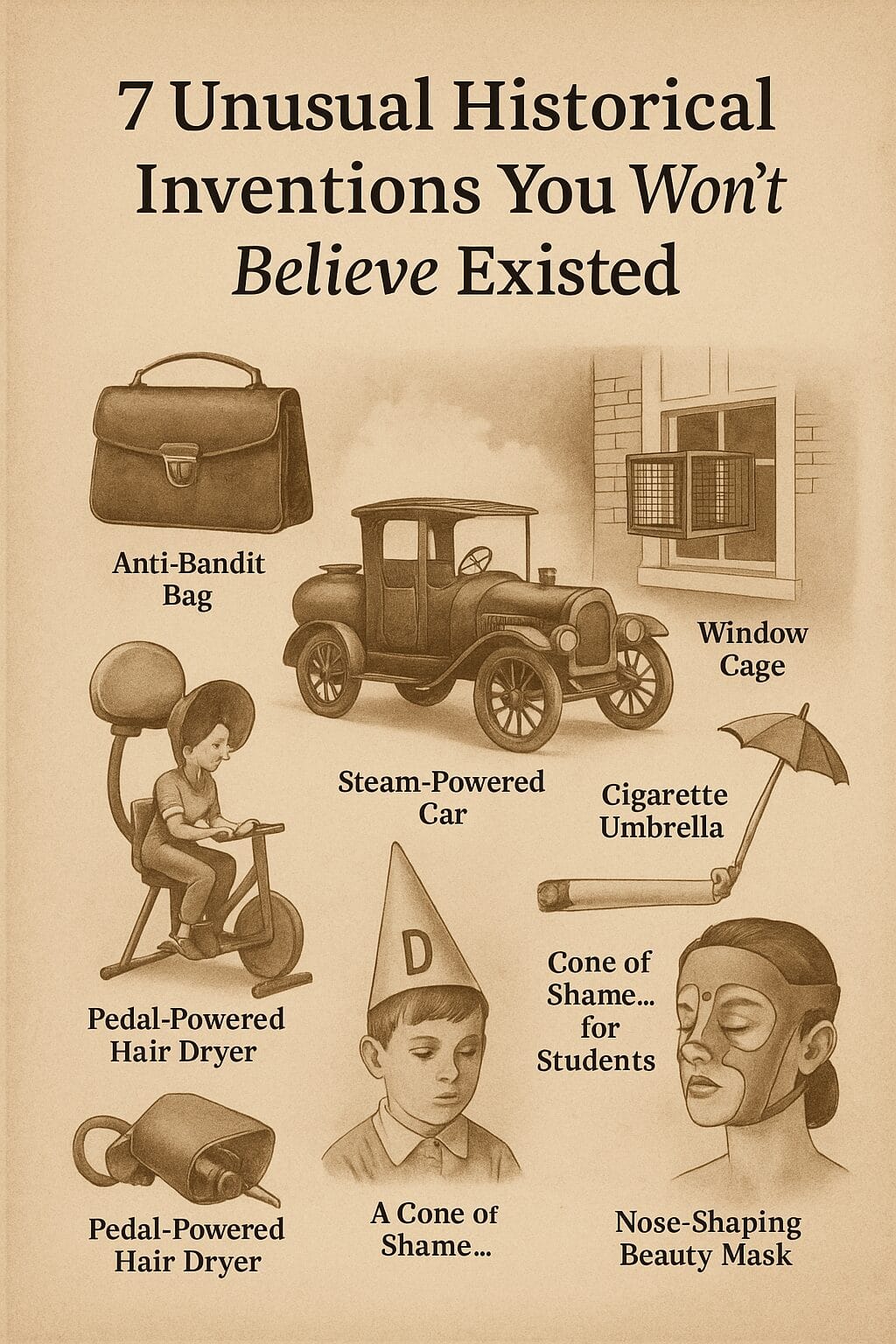

Unusual historical inventions give us a fascinating glimpse into the past—where human creativity often met eccentricity head-on. From strange beauty contraptions to dangerous early machines, these curious designs reveal how people tried to solve problems with the knowledge and tools they had at the time. Here are 7 unusual historical inventions you won’t believe actually existed.
Many of these devices were born from real needs: better security, improved health, or simple convenience. Others came from experimentation or marketing flair. Whether ingenious or impractical, these unusual historical inventions show just how inventive—and sometimes amusing—human innovation can be.
1. The Anti-Bandit Bag (1920s)
This clever but clunky device was designed to protect women from purse snatchers. When a thief grabbed the bag, a hidden mechanism snapped it shut, trapping their hand inside. While it worked in theory, it often trapped the owner’s own hand as well. It’s one of those unusual historical inventions that worked on paper but stumbled in real life.
2. Baby Cages Hung Out of Windows
In early 20th-century London, some parents installed wire cages outside their apartment windows so babies could get “fresh air.” These unusual historical inventions were marketed as health-boosting tools for urban families, but modern eyes see them as both fascinating and alarming.
3. The Pedal-Powered Hair Dryer
Before electricity was common, salons relied on creative solutions. One person pedaled a stationary bike to generate airflow while another styled hair. It’s one of those unusual historical inventions that shows how necessity can lead to surprisingly odd setups.
4. Cigarette Umbrellas
In the 1930s, inventors tackled the “rainy day smoking” problem by designing tiny umbrellas that clipped onto cigarettes. Though marketed seriously, these quirky accessories were more comedic than practical—an amusing chapter in the story of unusual historical inventions.
5. The Cone of Shame… for Students
Some 19th-century schools used “discipline cones” — large cardboard cones placed on children’s heads to shame them for misbehavior. Unlike today’s pet cone, these were humiliating punishments. It’s another striking example of how unusual historical inventions reflected the values of their time.
6. Steam-Powered Cars with Explosive Boilers
Before gasoline engines took over, inventors experimented with steam-powered cars. Some worked well, but others were dangerously unstable. A few featured boilers mounted behind the driver that could explode if pressure wasn’t carefully controlled. These risky unusual historical inventions helped pave the way for safer automotive engineering.
7. The Nose-Shaping Beauty Mask
Sold to women in the 1930s, this mask claimed to “reshape” noses overnight by clamping them tightly. It didn’t work, but it perfectly represents how unusual historical inventions often targeted personal insecurities with bold promises.
Why These Unusual Historical Inventions Matter
Looking back at these unusual historical inventions is entertaining, but it also highlights important lessons. Innovation has always involved trial and error, with both brilliant and questionable ideas contributing to progress. These devices show how cultural values, technology, and marketing shaped invention. Some sparked future advancements; others vanished as curiosities. Together, they remind us that creativity isn’t always neat—but it’s always revealing.
FAQ
What are unusual historical inventions?
They are odd, creative, or unconventional devices from the past that were designed to solve problems in unexpected ways.
Why were unusual historical inventions created?
Many were attempts to solve real challenges with the technology available at the time. Others were driven by trends, marketing, or experimentation.
Did any unusual historical inventions actually work?
Some did, at least partially, while others failed or faded away. A few even inspired future innovations.
Are unusual historical inventions valuable today?
Yes—original examples of these devices are often prized by collectors and historians for their uniqueness and cultural significance.
Helpful Resources
- Smithsonian Magazine — Articles on strange and historical inventions.
- History.com — Deep dives into weird historical facts.
- Atlas Obscura — Explore oddities from around the world.
Explore More on AnswerNimbus
Love quirky history? Check out more Other Curiosities or explore Fascinating Facts & Explanations for more thought-provoking reads.

AnswerNimbus publishes practical how-tos, definitions, and tech help for everyday users.
Equilibrado de piezas
El equilibrado constituye un proceso fundamental en el mantenimiento de maquinaria agricola, asi como en la produccion de ejes, volantes, rotores y armaduras de motores electricos. Un desequilibrio provoca vibraciones que aceleran el desgaste de los rodamientos, provocan sobrecalentamiento e incluso pueden causar la rotura de los componentes. Para evitar fallos mecanicos, es fundamental identificar y corregir el desequilibrio de forma temprana utilizando metodos modernos de diagnostico.
Principales metodos de equilibrado
Existen varias tecnicas para corregir el desequilibrio, dependiendo del tipo de pieza y la magnitud de las vibraciones:
Equilibrado dinamico – Se aplica en elementos rotativos (rotores, ejes) y se realiza en maquinas equilibradoras especializadas.
El equilibrado estatico – Se emplea en volantes, ruedas y piezas similares donde es suficiente compensar el peso en un unico plano.
Correccion del desequilibrio – Se realiza mediante:
Perforado (eliminacion de material en la zona mas pesada),
Instalacion de contrapesos (en ruedas, aros de volantes),
Ajuste de masas de balanceo (como en el caso de los ciguenales).
Diagnostico del desequilibrio: equipos utilizados
Para detectar con precision las vibraciones y el desequilibrio, se utilizan:
Equipos equilibradores – Permiten medir el nivel de vibracion y definen con precision los puntos de correccion.
Analizadores de vibraciones – Registran el espectro de oscilaciones, identificando no solo el desequilibrio, sino tambien fallos adicionales (como el desgaste de rodamientos).
Sistemas laser – Se usan para mediciones de alta precision en componentes criticos.
Las velocidades criticas de rotacion requieren especial atencion – condiciones en las que la vibracion se incrementa de forma significativa debido a la resonancia. Un equilibrado adecuado evita danos en el equipo bajo estas condiciones.