
How earth formed is one of the most fascinating scientific stories ever told — a cosmic journey that spans billions of years and explains how tiny particles floating in space transformed into the vibrant, life-filled world we know today. By exploring how earth formed, we gain insight into the dramatic events and processes that shaped not only our planet but also the conditions for life itself.
1. Cosmic Dust Begins the Journey
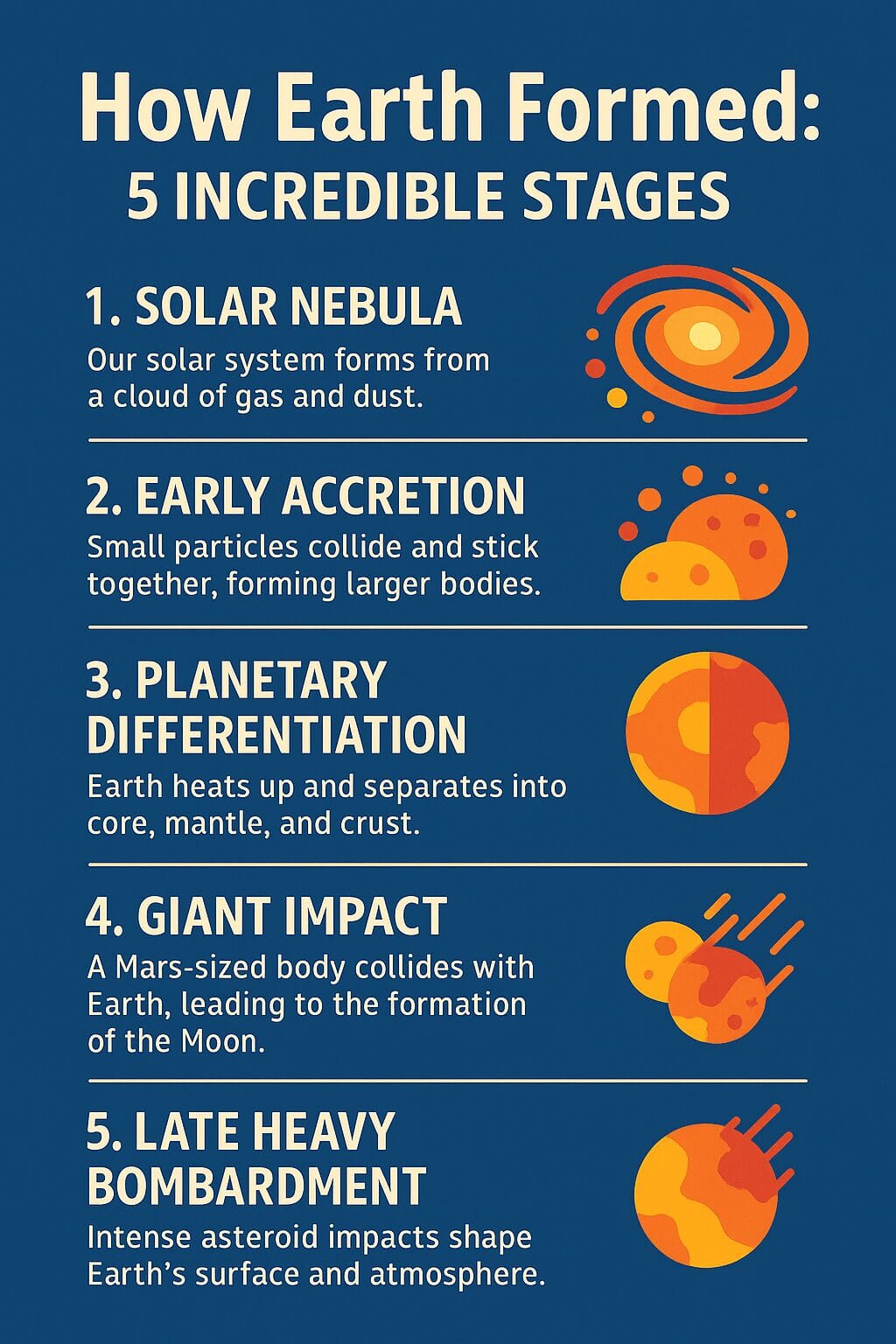
Roughly 4.6 billion years ago, before Earth even existed, our Solar System was nothing more than a massive rotating cloud of gas and dust called a solar nebula. Over time, gravity caused the nebula to collapse inward, spinning faster and flattening into a disk. At its center, the Sun ignited, while the remaining material in the disk began to clump together through a process called accretion. Small grains of dust collided and stuck together, forming larger and larger aggregates. These building blocks, known as planetesimals, were the seeds from which planets would grow. This early stage is essential to understanding how earth formed from simple cosmic materials.
2. Planetesimals Merge to Create a Proto-Earth
As millions of planetesimals continued colliding over millions of years, their gravitational pull allowed them to merge into larger bodies called protoplanets. One of these became the proto-Earth. However, this wasn’t a peaceful process — collisions were frequent and incredibly energetic. The heat generated by these impacts, along with radioactive decay inside the planet, kept Earth’s surface molten. Heavier elements like iron and nickel sank toward the center, forming the core, while lighter elements floated upward to create the mantle and crust. This internal differentiation was a crucial step in how earth formed its layered structure that persists today.
During this stage, the young Earth was continuously bombarded by leftover debris, adding mass and shaping its terrain. If you could have observed this time, you would have seen a glowing, chaotic ball surrounded by swirling rocks — a stark contrast to the stable planet we know today.
3. A Collision with Theia Changes Everything
One of the most dramatic moments in how earth formed came around 4.5 billion years ago, when a Mars-sized protoplanet called Theia collided with the proto-Earth. This impact was so powerful that it vaporized parts of both bodies, ejecting enormous amounts of debris into orbit. Over time, this debris coalesced to form our Moon. This event also re-melted much of Earth’s surface, mixing materials from Theia and Earth together. Geological evidence suggests that this collision tilted Earth on its axis, giving us the seasons, and stabilized the planet’s rotation, which helped create the conditions for long-term climate stability.
Without this collision, Earth might not have the Moon — and without the Moon’s gravitational pull regulating tides and stabilizing the tilt, life on Earth could have developed very differently. This makes the Theia impact one of the defining episodes in the story of how earth formed.
4. Cooling, Crust Formation, and the First Atmosphere
After the Theia impact, Earth gradually began to cool. A solid crust formed over the molten surface, although volcanic activity remained intense. These volcanoes released gases trapped inside the planet, including water vapor, carbon dioxide, nitrogen, and sulfur compounds. This outgassing formed Earth’s first primitive atmosphere — one very different from today’s oxygen-rich air. As temperatures fell, water vapor condensed and created the first oceans, turning Earth into a “blue planet.”
This stage was crucial to how earth formed into a habitable environment. The presence of liquid water and a stable crust set the stage for the chemical reactions that would eventually lead to life. At the same time, Earth’s magnetic field began to form due to movements in its iron core, shielding the surface from harmful solar radiation.
5. Bombardment Ends, Life Begins
For hundreds of millions of years, Earth continued to experience frequent impacts from asteroids and comets during a period known as the Late Heavy Bombardment. These collisions sterilized the surface multiple times, delaying the emergence of life. But as the bombardment slowed down around 3.8 billion years ago, Earth became more stable. Oceans, atmosphere, and geology interacted in complex ways, and the first simple life forms — likely single-celled organisms — emerged not long after.
Understanding this stage is key to answering how earth formed into a world that could support life. The combination of a stable climate, liquid water, and a protective atmosphere created a rare cosmic recipe that allowed biology to flourish.
FAQ
How long did it take for Earth to form?
Most of the formation occurred within the first 100 million years of the Solar System. Accretion, differentiation, and the Theia impact were completed relatively quickly on cosmic timescales, but Earth’s surface and atmosphere continued evolving for billions of years afterward.
Was Earth always suitable for life?
No. Early Earth was extremely hostile, with high temperatures, toxic gases, and frequent impacts. It took hundreds of millions of years of cooling and atmospheric development before conditions stabilized enough for life to appear.
How do scientists know how Earth formed?
They study meteorites, lunar samples, Earth’s oldest rocks, and astronomical observations of other forming planetary systems. These pieces of evidence, combined with computer models, provide a clear picture of how earth formed.
Why is this story important?
Understanding how earth formed not only reveals our origins but also helps scientists predict how other planets might form and whether they could support life.
Helpful Resources
Explore More on AnswerNimbus
Love learning about our planet’s past? Check out more articles in Facts & Explanations or explore our practical guides in How-To & Fixes.

AnswerNimbus publishes practical how-tos, definitions, and tech help for everyday users.