
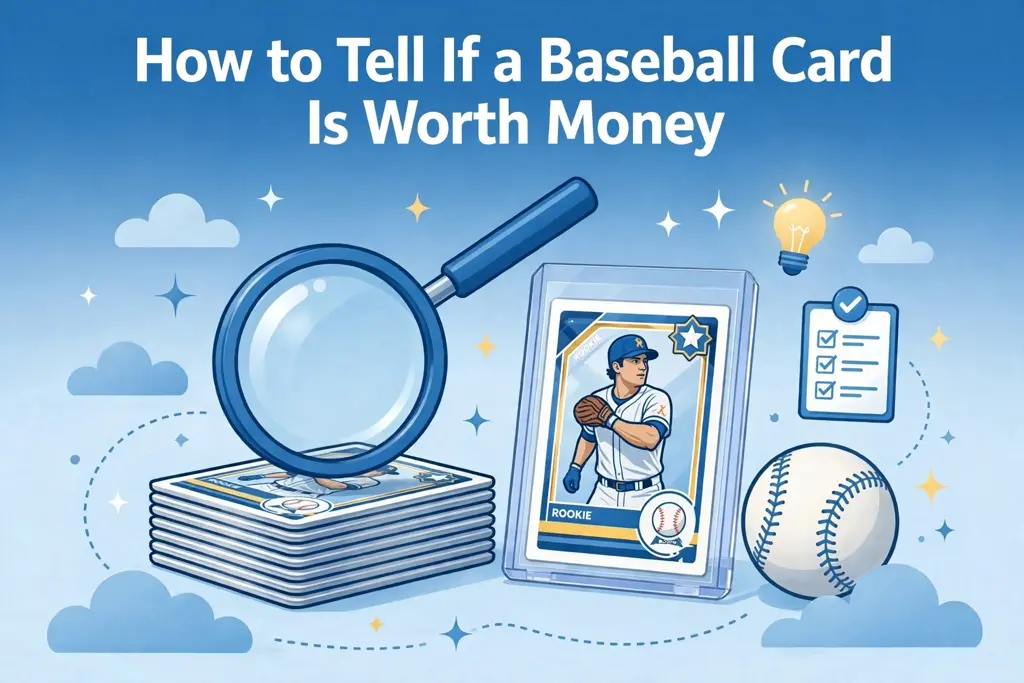
How to Tell If a Baseball Card Is Worth Money: 7 Checks Before You Sell
Almost every family has one: a shoebox or binder of old baseball cards, inherited or rediscovered, and the same hopeful question — is any of this worth something? The honest answer is that most cards are worth very little, and a small minority are worth a great deal. Learning how to tell if a baseball card is worth money means sorting one from the other, and it comes down to seven checks you can do at a kitchen table.
Check 1: The Player
Value follows fame. Cards of Hall of Famers and era-defining stars — Mantle, Aaron, Mays, Clemente, Griffey Jr., Jeter — carry demand that common players never will, and perennial fan favourites hold value even without a plaque in Cooperstown. A box full of star cards deserves careful attention; a box of journeymen relievers usually does not.
Check 2: The Year and the Era
The year printed on the back is the fastest scarcity filter you have. Pre-war cards (before 1945, like the 1909–11 T206 set and 1933 Goudey) were printed in small numbers on cheap stock, and few survived — they are prized across the board. Vintage cards (1948–1979) are the golden age: the 1952 Topps and 1955 Topps sets are loaded with valuable rookies and stars. Then comes the trap: the "junk wax" era of the mid-1980s to early 1990s, when Topps, Fleer, and Donruss printed cards by the millions. Nearly everything from those years is worth pennies today, no matter whose face is on it. Modern cards flip the logic — base cards are cheap, but autographs, jersey-relic cards, and serial-numbered parallels are where the money is.
Check 3: Is It a Rookie Card?
A player's true rookie card — their first card in a major set, often marked "RC" on modern issues — is almost always their most valuable card from any set. The famous exceptions that prove junk-wax value exists are nearly all rookies: the 1989 Upper Deck Ken Griffey Jr., the 1993 SP Derek Jeter (a foil card that is notoriously hard to find in top condition). When sorting a box, pull the rookies first.
Check 4: Condition — The Great Multiplier
Condition is where values explode or evaporate. Graders judge four things: corners (sharp and pointed, or rounded and frayed?), edges (clean, or chipped?), surface (free of scratches, stains, and print defects — a single crease is a value killer), and centering (is the border even on all sides?). The gap is enormous: a top-grade example can sell for ten to a hundred times the same card in rough shape. Handle candidates by the edges, and get anything promising into a sleeve and top loader before you do anything else.
Check 5: Errors, Parallels, and Special Versions
Some cards are valuable because they are different. Famous error cards — like the 1990 Topps Frank Thomas rookie missing its name on the front — command big premiums. In modern sets, look for refractor and parallel versions, and any card stamped with a serial number like /25 or /100: low print runs are built-in scarcity. An autograph from the manufacturer (not signed later by hand) adds value too.
Check 6: What It Actually Sells For
Never trust asking prices. Search your card on eBay — year, brand, card number, player — and filter to Sold Items. That is the real market: what people actually paid, recently, for your exact card in comparable condition. Price guides from grading companies like PSA are useful for graded values, but sold listings are the ground truth for the card in your hand.
Check 7: Should You Get It Graded?
Professional grading by PSA, BGS, or SGC (graded 1 to 10, sealed in a slab) can multiply a card's price — but grading costs money per card, plus shipping and insurance. The math only works for cards that are genuinely desirable and likely to grade high. A flawless key rookie is a candidate; a junk-wax common with soft corners is not, no matter what it grades. Never clean, trim, or "restore" a card yourself — altered cards are flagged by graders and can become nearly worthless.
A 10-Minute Triage for a Whole Box
Sort by era first and set the junk-wax commons aside. Pull every star and every rookie card. Inspect those under good light for corners, surface, and centering. Check sold prices for the survivors. Sleeve anything with real potential. That hour of sorting is the difference between selling a treasure for box price and knowing exactly what you have.
Quick Summary
A baseball card is worth money when the right player (ideally a rookie card), the right era (pre-1980 vintage, not junk wax), and top condition line up — with errors, autographs, and numbered parallels as bonuses. Always confirm value with eBay's sold listings, never asking prices, and only pay for professional grading when a desirable card is clean enough for the grade premium to beat the fee.
Frequently Asked Questions
Are baseball cards from the 1980s and 1990s worth anything?
Mostly, no. The junk wax era's massive print runs mean even star cards from those years are usually worth very little. The exceptions are key Hall of Fame rookies in pristine, professionally graded condition — like the 1989 Upper Deck Griffey Jr.
What is the most valuable baseball card?
The 1952 Topps Mickey Mantle holds the record, selling for $12.6 million — a legendary player combined with extreme scarcity in top condition. The T206 Honus Wagner is its famous rival.
Should I clean an old card to make it look better?
Never. Cleaning, trimming, or pressing a card counts as alteration. Graders detect it, collectors avoid it, and it can turn a valuable card into a nearly worthless one. Sell honest condition instead.
Where should I sell valuable cards?
eBay's sold market is the standard for most cards. For high-value graded cards, major auction houses that specialize in sports collectibles attract the deepest-pocketed buyers. Either way, know your card's sold-price history first.
Related Guides
- 10 Proven Ways to Spot Fake Sports Cards (Like a Pro)
- 10 Expert Tips to Spot Fake Pokémon Cards (Like a Pro)
- How to Tell if a Pokémon Card Is First Edition: 7 Proven Ways
External Resources
More in Collectibles
How to Tell If a Comic Book Is Worth Money: 7 Checks Before You Sell
How to Tell If a Comic Book Is Worth Money: 7 Checks Before You Sell Somewhere between the attic boxes and the long boxes at the comic shop sits the same question baseball card collectors ask: is any…

Are Beanie Babies Worth Anything? The Honest Answer (It's Not $500,000)
Are Beanie Babies Worth Anything? The Honest Answer (It's Not $500,000) Search for the Princess Diana Beanie Baby and you will find listings asking $500,000 — sometimes more. Then check what one…
10 Proven Ways to Spot Fake Sports Cards (Like a Pro)
Trying to spot fake sports cards ? This guide gives you 10 proven checks—used by collectors and graders—so you can confidently buy, sell, and trade. By the end, you’ll know how to spot fake sports…