

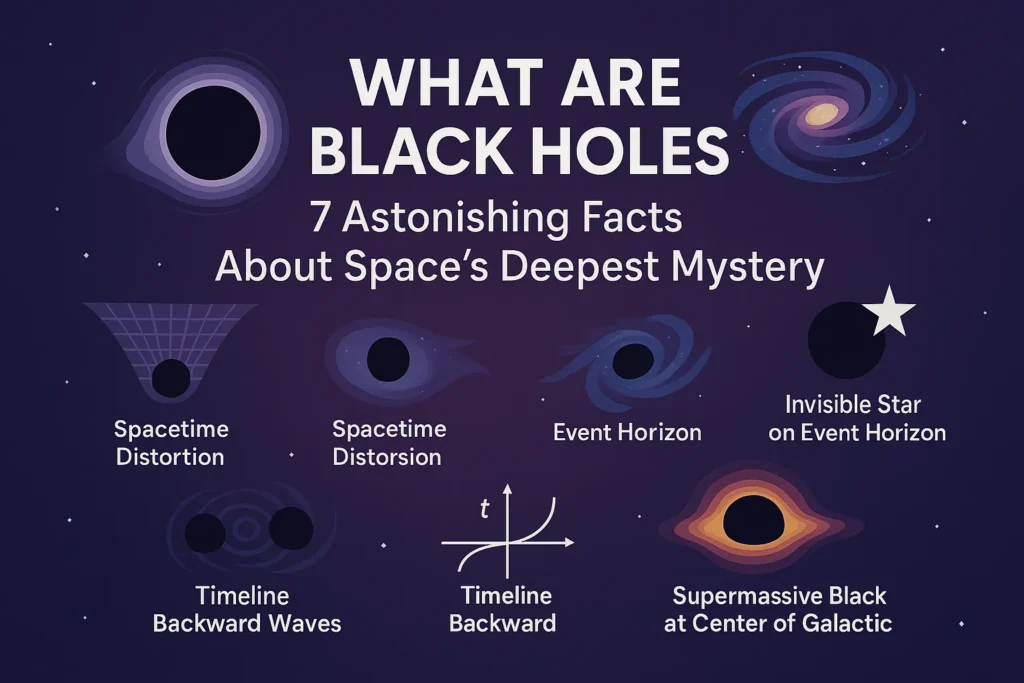
What are black holes? In simple terms, they are regions of space where gravity is so intense that nothing—not even light—can escape. Understanding what are black holes helps explain how stars die, how galaxies evolve, and why space-time itself can be stretched, twisted, and warped in astonishing ways.
Quick Answer (in 3 lines)
- What are black holes? Ultra-dense objects with escape velocities faster than light.
- They form when massive stars collapse or when smaller black holes merge.
- We detect them by their effects: warped light, X-ray hot disks, and gravitational waves.
1) Event Horizons and Space-Time: Why Nothing Escapes
The boundary of a black hole is the event horizon. Crossing it means no return. To grasp what are black holes, picture space-time as a fabric: mass makes dents, and a black hole makes a bottomless well. Near the horizon, time dilation becomes extreme—an outside observer would see a falling clock tick slower and slower.
2) How They Form: Stellar Collapse, Mergers, and the Early Universe
Most known black holes form when a massive star runs out of nuclear fuel and its core collapses. Others are born when two neutron stars or smaller black holes merge. Scientists also theorize primordial black holes from the early universe. So, when we ask what are black holes made from, the answer is: the compressed remnants of extreme astrophysical events.
3) Sizes: From Stellar to Supermassive (and Maybe Intermediate)
Understanding what are black holes includes their scale:
- Stellar-mass (a few to dozens of Suns): form from single star collapses.
- Intermediate-mass (hundreds to thousands of Suns): evidence is mounting in dense star clusters.
- Supermassive (millions to billions of Suns): sit in most galactic centers, including the Milky Way’s Sagittarius A*.
4) They Don’t “Vacuum” Space—Orbits Still Work
A common myth about what are black holes is that they “suck up” everything. If the Sun were magically replaced by a black hole of the same mass (don’t worry, it won’t be), Earth would continue orbiting almost exactly as before—just without sunlight. Black holes are extreme, but gravity still follows the same rules.
5) Accretion Disks, Jets, and Brilliant Energy
Material spiraling toward a black hole forms an accretion disk that heats up and shines in X-rays. Some systems launch relativistic jets—narrow beams of particles moving near light speed. These signatures help astronomers study what are black holes even though the holes themselves emit no light.
6) Seeing the Invisible: Lensing, Ripples, and Direct Images
We “see” black holes indirectly. Three major clues:
- Gravitational lensing: a black hole bends light, magnifying or distorting background objects.
- Gravitational waves: LIGO/Virgo detect ripples in space-time from black hole mergers.
- Silhouette imaging: The Event Horizon Telescope produced the first images of a black hole’s shadow (M87*) and our own galaxy’s Sgr A*.
Each method refines our answer to what are black holes by revealing their mass, spin, and environment.
7) Do Black Holes Live Forever? (Hawking Radiation)
Stephen Hawking showed that quantum effects allow black holes to emit a faint glow—Hawking radiation—and slowly lose mass. For stellar or supermassive black holes, this evaporation is unimaginably slow, but it changes how physics answers what are black holes at the deepest level—where gravity meets quantum mechanics.
Common Misconceptions
- “Black holes roam and eat galaxies.” Most are anchored by gravity in systems like binaries or galactic centers.
- “Anything near a black hole gets swallowed.” Stable orbits exist; only crossing the event horizon guarantees no return.
- “They break physics.” They test physics—especially general relativity and quantum theory.
Why Black Holes Matter
To really answer what are black holes, consider their cosmic role: they influence star formation, regulate galactic growth via energetic feedback, and provide laboratories for extreme physics. Studying them helps us probe gravity, light, and matter under the most intense conditions known.
FAQ
What are black holes in simple terms?
They are ultra-dense regions of space with gravity so strong that nothing can escape once it passes the event horizon.
How do scientists detect black holes if they’re invisible?
By their effects: hot accretion disks (X-rays), gravitational lensing, the motion of nearby stars, gravitational waves from mergers, and horizon “shadows” imaged by the Event Horizon Telescope.
Can the Sun turn into a black hole?
No. The Sun isn’t massive enough. It will end as a white dwarf, not a black hole.
Do black holes “suck” everything in?
No. Their gravity acts like any other mass. Only objects that stray too close risk crossing the event horizon.
Helpful Resources
- NASA — Black Holes Overview
- Event Horizon Telescope
- ESA — Black Holes
- Encyclopaedia Britannica — Black Hole
Explore More on AnswerNimbus
Enjoy space explainers like this? Browse more in Facts & Explanations or check practical guides in How-To & Fixes. For a related read, see our posts on supernovas and other cosmic phenomena in the same category.
“`0
AnswerNimbus publishes practical how-tos, definitions, and tech help for everyday users.