
What Does Déjà Vu Mean? From a French Phrase to a Brain Glitch
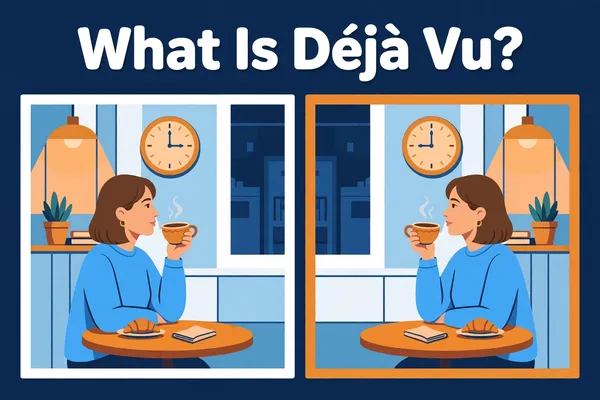
You walk into a café you have never visited, and for a few strange seconds you are certain you have been there before. You know the feeling is wrong — you can even see that it is wrong — but the sense of familiarity is so strong it is hard to shake. That is déjà vu, and if you have ever had it, you are in the majority. So what does déjà vu mean, and why does the brain produce a feeling it knows is false?
The phrase is French, and it translates simply as "already seen." It was first used in 1876 by the French philosopher Émile Boirac, who described the sensation in a letter published in the journal Revue Philosophique. It took another two decades before the term was formally adopted by scientists, when French neurologist F. L. Arnaud proposed its use at a meeting of the Société Médico-Psychologique. Before Boirac gave it a name, people had been describing the experience for centuries — Charles Dickens wrote about it in David Copperfield, and Sigmund Freud wrote about a version of it on the Acropolis — but nobody had a tidy word for it.
How Common Is Déjà Vu?
Very. Surveys consistently find that roughly two-thirds of people have experienced déjà vu at least once in their lives, and some studies put the figure as high as 70 to 80 percent. It is most common in young adults: people tend to first experience it around age six or seven, it peaks between the ages of 15 and 25, and it becomes less frequent as we get older. It also shows up more often in people who travel frequently, watch a lot of films, or remember their dreams well — all activities that feed the brain a rich supply of scenes to feel familiar about.
An episode is usually brief, lasting somewhere from 10 to 30 seconds. That brevity is one reason déjà vu is so hard to study. There is no button a researcher can press to make it happen on demand, and by the time someone reports it, it is already over. Scientists have tried to trigger it in the laboratory with hypnosis and with virtual reality scenes, with mixed results, which is why much of what we know comes from surveys and from careful reasoning about how memory works.
What Is Actually Happening in the Brain?
There is no single agreed explanation, but the leading ideas all treat déjà vu as a small error in the memory system rather than anything supernatural. The most widely supported account is a mismatch between two parts of memory that normally agree with each other: the feeling of familiarity, and the actual recollection of an event. Normally they arrive together. In déjà vu, the familiarity signal fires without any matching memory behind it, so the present moment feels known even though nothing in your past explains why.
One version of this idea focuses on the temporal lobe, the part of the brain heavily involved in memory. In people with temporal lobe epilepsy, déjà vu can appear as an aura — a warning sensation just before a seizure — and stimulating the temporal lobe during brain surgery has been known to trigger the feeling. That does not mean ordinary déjà vu is a mini-seizure; in healthy people it is far too brief and too mild for that. But it does suggest the same circuitry is involved, and that a small, spontaneous misfire there can produce the sensation.
Another explanation is subtler and more everyday. It is called the gestalt familiarity theory, and it says déjà vu happens when a new scene shares its overall layout with a scene from your past, even though the details are different. You walk into a café with the same arrangement of counter, windows, and tables as a café you visited years ago, and your brain registers the pattern before your conscious mind can sort out that the details do not match. The feeling of recognition arrives first; the correction arrives a moment later. The mismatch between the two is the eerie part.
Is Déjà Vu a Premonition?
No — and this is the part where the science is clearest. Déjà vu feels like a prediction because the familiarity is so convincing, but studies that have tried to test whether people in a déjà vu state can actually predict what happens next have found no such ability. The feeling is retrospective, not prophetic: it is your memory system mislabelling the present, not your brain glimpsing the future. It is also not a memory of a past life, a parallel universe, or a glitch in a simulated reality, however fun those explanations are. The honest, less cinematic answer is that it is a normal, common hiccup in a system that usually works so well we never notice it.
When Should You Mention It to a Doctor?
Ordinary déjà vu — brief, occasional, and gone in seconds — is not a medical concern. It becomes worth mentioning if it changes character: if it starts happening very frequently, lasts much longer than half a minute, comes with confusion or a loss of awareness, or is followed by unusual smells, tastes, or a sense of unreality. Those patterns can occasionally be associated with temporal lobe epilepsy, where déjà vu acts as an aura before a seizure. The distinction is not the feeling itself but the company it keeps. A few seconds of "I have been here before" once in a while is one of the most normal quirks the human brain has. Several episodes a week, or episodes that leave you disoriented, deserve a conversation with a doctor.
Why It Fades With Age
One of the more interesting findings is that déjà vu becomes rarer as people get older, even though older people have far more memories to confuse with the present. Researchers think the reason is that the memory system becomes less prone to the particular kind of error involved: with age, the brain is slower to generate the strong, false familiarity signal, and more cautious about labelling something as known. Younger brains, by contrast, are quick, associative, and eager to find patterns — which is also why déjà vu peaks in the years when people are travelling, meeting new people, and encountering new places constantly. It is, in a sense, a side effect of a memory system that is working at full speed.
Quick Summary
Déjà vu is French for "already seen," a term first used by Émile Boirac in 1876. About two-thirds of people experience it at least once, most often between ages 15 and 25, and an episode usually lasts 10 to 30 seconds. Scientists explain it as a brief mismatch in the memory system — a feeling of familiarity firing without a matching memory — possibly involving the temporal lobe. It is not a premonition, and ordinary occasional déjà vu is completely normal.
Frequently Asked Questions
What does déjà vu literally mean?
It is French for "already seen." The term was coined in 1876 by the French philosopher Émile Boirac, who used it to describe the strange feeling that a new experience has happened before.
How common is déjà vu?
Very common. Roughly two-thirds of surveyed populations report experiencing déjà vu at least once in their lives, with some studies putting the figure at 70 percent or more. It is most frequent between the ages of 15 and 25 and becomes less common with age.
What causes déjà vu?
The leading explanation is a brief error in the memory system: the brain's feeling of familiarity fires without any actual matching memory, so the present feels known even though it is new. Research points to the temporal lobe, and one theory says a new scene's layout matches a forgotten scene from the past closely enough to trigger false recognition.
Is déjà vu a sign of a medical problem?
Occasional, brief déjà vu is normal and not a concern. It is worth mentioning to a doctor if it becomes very frequent, lasts longer than about 30 seconds, comes with confusion or loss of awareness, or is followed by strange smells or a sense of unreality, since those patterns can occasionally relate to temporal lobe epilepsy.
Related Guides
- What Does Nostalgia Mean? From a 17th-Century Diagnosis to a Bittersweet Feeling
- What Does Serendipity Mean? From a Fairy Tale to a Lucky Accident
- What Is the Butterfly Effect? 7 Fascinating Facts That Explain It
External Resources
More in Definitions

What Does Serendipity Mean? From a Fairy Tale to a Lucky Accident
What Does Serendipity Mean? From a Fairy Tale to a Lucky Accident We have all had the experience: you go looking for one thing and stumble on something else, something better, that you were not…

What Does Nostalgia Mean? From a 17th-Century Diagnosis to a Bittersweet Feeling
What Does Nostalgia Mean? From a 17th-Century Diagnosis to a Bittersweet Feeling Put on a song you have not heard since high school, and something complicated happens. You feel warmth, and you feel…
What Is Déjà Vu? The Brain Glitch Behind the Eeriest Feeling
What Is Déjà Vu? The Brain Glitch Behind the Eeriest Feeling You walk into a café you have never visited, in a city you have never been to — and you would swear you have sat at that exact table…