

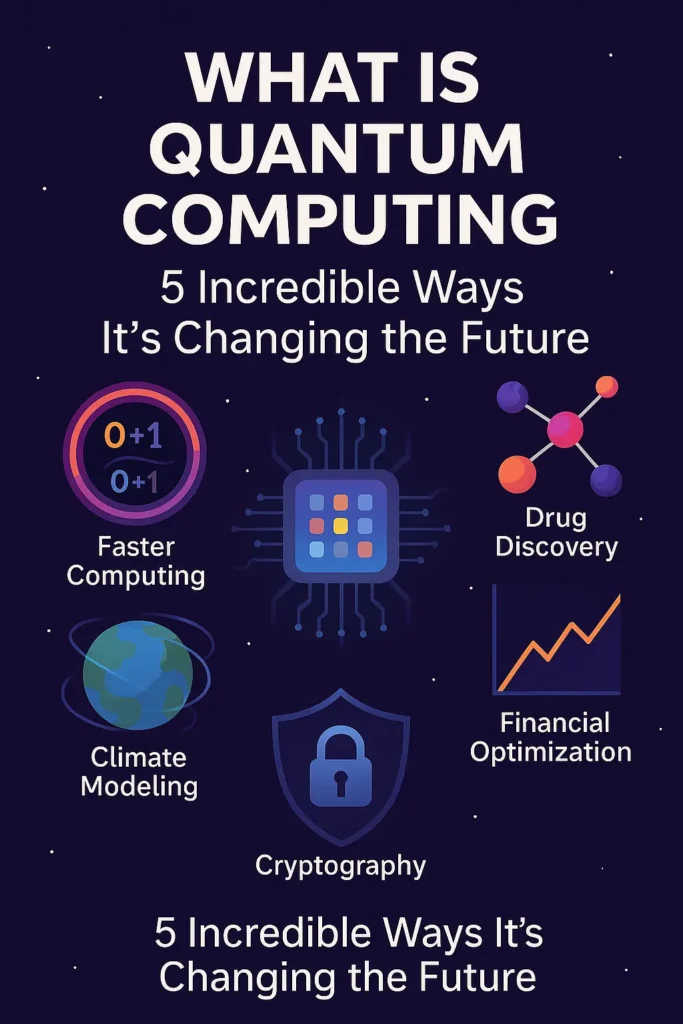
What is quantum computing? It’s one of the most revolutionary advancements in modern science — a new way of processing information that could transform how we solve problems, secure data, and explore the universe. Unlike traditional computers, which use bits that can be either 0 or 1, quantum computers use quantum bits, or qubits, that can exist in multiple states simultaneously. Understanding what is quantum computing gives us a glimpse into a future where computing power grows beyond imagination.
1. Quantum Computing Uses the Power of Superposition
At the heart of what is quantum computing lies the principle of superposition. This means that a quantum bit can represent both 0 and 1 at the same time. Because of this, quantum computers can perform multiple calculations simultaneously, giving them the potential to solve problems that would take classical computers thousands of years to process.
2. It Leverages Quantum Entanglement for Extreme Processing Power
Another fascinating part of what is quantum computing is quantum entanglement — a mysterious connection that links qubits even when they’re separated by large distances. When qubits become entangled, the state of one instantly affects the other. This allows quantum computers to process and share information in ways that seem almost instantaneous, dramatically boosting performance and efficiency.
3. Quantum Computing Could Revolutionize Data Security
One of the most exciting aspects of what is quantum computing is its impact on cybersecurity. Traditional encryption methods rely on mathematical problems that are extremely difficult for classical computers to solve. However, a sufficiently powerful quantum computer could break those encryptions in seconds. At the same time, quantum mechanics also offers new, nearly unbreakable encryption methods called “quantum key distribution,” which could protect data in ways never before possible.
4. It’s Transforming Artificial Intelligence and Machine Learning
When people ask what is quantum computing in the context of AI, the answer is simple: it’s the next leap forward. Quantum algorithms can process vast data sets much faster than conventional systems, enabling more accurate predictions, smarter pattern recognition, and faster model training. This could accelerate innovation in areas like climate modeling, financial forecasting, and drug discovery — changing how we approach global challenges.
5. Quantum Computers Could Redefine the Future of Science and Industry
In exploring what is quantum computing, scientists are finding new ways to simulate the laws of nature at the atomic level. Quantum simulations can model chemical reactions, materials, and biological systems with unprecedented accuracy. This means future discoveries in energy, medicine, and materials science could arrive decades sooner. The potential applications are endless — from designing ultra-efficient solar panels to creating life-saving pharmaceuticals faster than ever before.
How Far Are We From Everyday Quantum Computing?
While the concept of what is quantum computing sounds futuristic, progress is already well underway. Companies like IBM, Google, and startups such as IonQ and Rigetti are building real quantum processors. Governments worldwide are investing billions into research to make these machines more stable, reliable, and accessible. Although still in its early stages, the race toward practical quantum computing has already begun — and its winners will define the next technological era.
FAQ
What is quantum computing in simple terms?
Quantum computing is a new way of processing information using qubits, which can represent multiple values at once. This lets quantum computers solve certain problems much faster than regular computers.
Can quantum computers replace traditional computers?
Not entirely. Quantum computers are designed for complex, specialized calculations like cryptography or simulations, while classical computers remain better for everyday tasks like browsing or word processing.
How does quantum computing affect data security?
Quantum computing can both threaten and strengthen cybersecurity. While it can break traditional encryption, it also enables new forms of encryption that are theoretically unbreakable.
Is quantum computing already being used?
Yes, in limited ways. Organizations like NASA and IBM use early quantum systems for research, optimization, and simulations, but commercial use is still in development.
What industries will benefit most from quantum computing?
Pharmaceuticals, finance, logistics, and energy industries are expected to see the biggest impact as quantum computing accelerates simulations, data analysis, and optimization problems.
Helpful Resources
- IBM Quantum Computing — Learn more about real-world progress in quantum technology.
- Google Quantum AI — Discover how Google is advancing quantum research.
- Scientific American: What Is Quantum Computing?
Explore More on AnswerNimbus
Curious about the universe of technology? Read more in our Facts & Explanations section or explore Other Curiosities to uncover more fascinating discoveries.
“`0
AnswerNimbus publishes practical how-tos, definitions, and tech help for everyday users.