
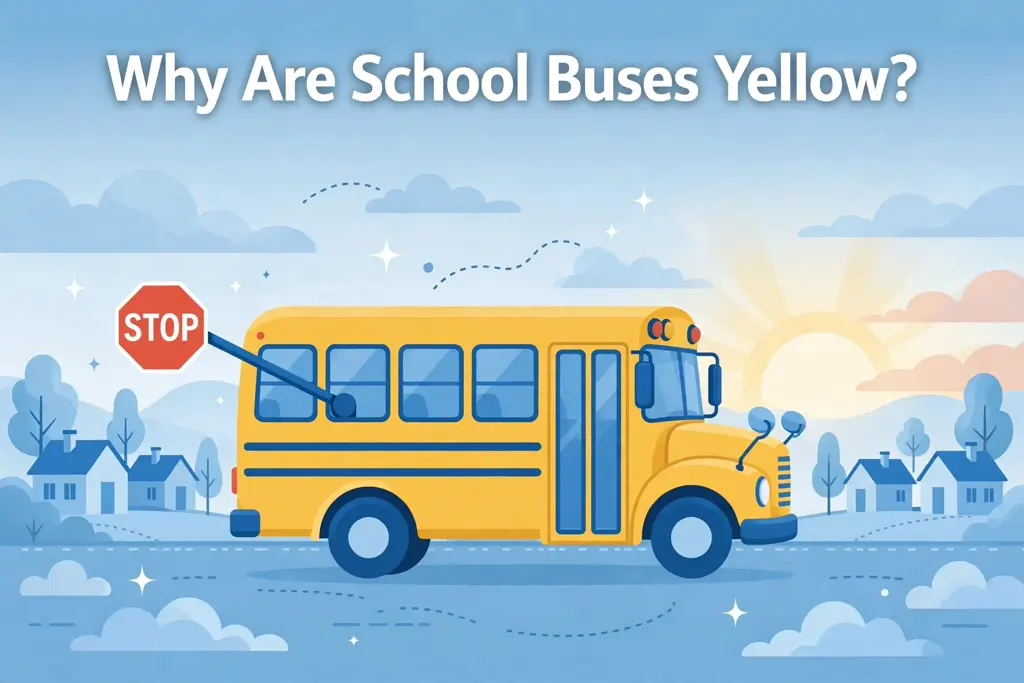
Why Are School Buses Yellow? The 1939 Decision That Stuck
Every school bus in North America wears the same shade — not just yellow, but one specific yellow-orange with its own official name. Nobody's district chose it last year, and no law of nature demands it. So why are school buses yellow? Because in the spring of 1939, a group of educators, engineers, and officials sat in a room for seven days, argued about everything from seat height to exit placement, and settled the colour question with surprising science.
The Short Answer
School buses are yellow because a 1939 national conference organized by rural-education specialist Frank W. Cyr adopted it as the standard colour for all of North America. The shade — officially named National School Bus Chrome, later renamed National School Bus Glossy Yellow — was picked because black lettering on it is easiest to read in the dim light of early morning and late afternoon, exactly when buses are on the road.
Before 1939: Every Colour Imaginable
Early school transport was chaos. In the 1920s and 1930s, children rode in whatever a district could find: trucks, automobiles, horse-drawn carts, even covered wagons with engines bolted on in parts of Wyoming. Buses came in every colour of the rainbow — one New York district ran small purple buses, another painted theirs red, white, and blue for patriotism. There were virtually no standards for size, construction, or safety, and manufacturers complained they could not build buses cheaply on an assembly line without them. Cyr, a professor at Teachers College, Columbia University, surveyed the mess in 1937 and decided to fix it.
The Conference That Picked a Colour
In April 1939, Cyr gathered state officials, school leaders, and bus engineers at Columbia for a seven-day conference funded to produce the first national standards for school transportation. The delegates adopted 44 standards covering bus size, engines, exits, and more. The most visible one was the colour: a particular yellow-orange was selected and formally designated National School Bus Chrome ("chrome" then referred to the lead-chromate pigment; when lead was removed from the paint, the name became National School Bus Glossy Yellow). Cyr is still remembered as the "Father of the Yellow School Bus."
The Science: Why This Yellow Wins
The delegates were not guessing. School buses do their work at the worst viewing times of day — dawn and dusk — often in fog, rain, and low sun. Three things work in this colour's favour. First, contrast: black letters on this yellow remain legible farther away, in worse light, than any combination they tested. Second, the colour itself sits in the band human eyes detect best — shades between yellow and green-yellow register quickly in peripheral vision, so a driver notices a bus at the edge of their sight sooner. Third, red fails at dawn: although red shouts "stop," it darkens toward black in low light, while yellow keeps its brightness. Look closely and the famous colour is not even pure yellow — it leans orange, which is part of why it holds up so well in dim conditions.
Does It Actually Work?
The colour is only one layer of a safety system that grew from the same standards movement: flashing red lights, the swing-out stop arm, high-backed padded seats, and retroreflective markings that outline the bus in headlights at night. Together they have made the school bus, by a wide margin, the safest way for children to get to and from school in North America. And the standardized colour does quiet psychological work, too: a driver anywhere on the continent instantly recognizes the shape and shade, and knows — before a single light flashes — that children are nearby.
Is It the Same Everywhere?
The standard is a North American one: the United States and Canada both use it, adopted through state and provincial specifications rather than one single law. Elsewhere, the rules vary — some countries favour white or orange for school transport, while others have adopted the North American yellow look precisely because it is so recognizable. The 1939 shade has quietly become the world's visual shorthand for "children on board."
Quick Summary
School buses are yellow because Frank W. Cyr's 1939 Columbia University conference made one specific yellow-orange — National School Bus Chrome, now Glossy Yellow — the North American standard. It was chosen because black lettering on it reads best at dawn and dusk, the human eye catches yellow fastest in peripheral vision, and unlike red it stays bright in low light. Before 1939, buses came in every colour, including purple.
Frequently Asked Questions
Is the yellow colour actually a law?
Not a single federal law — the 1939 standards were recommendations that states and provinces adopted into their own purchasing specifications. The result is the same: virtually every school bus in the US and Canada is painted the standard shade.
Why weren't school buses painted red for visibility?
Red is attention-grabbing in daylight but appears almost black in low light, and school buses work hardest at dawn and dusk. Yellow keeps its brightness and contrast in exactly the conditions buses operate in.
Is school bus yellow a pure yellow?
No — it sits between yellow and orange. That slight orange lean, combined with black lettering, is what made it the most legible and visible option the 1939 delegates tested.
Who was Frank W. Cyr?
A rural-education professor at Teachers College, Columbia University, who surveyed America's chaotic school transport in 1937 and organized the 1939 conference that standardized it. He is known as the Father of the Yellow School Bus.
Related Guides
- 7 Bizarre Historical Facts You Probably Never Learned
- 7 Unusual Historical Inventions You Won’t Believe Existed
- 7 Amazing Reasons Why Leaves Change Color in Fall
External Resources
More in Other Curiosities

Why Do Golf Balls Have Dimples? The Accident That Doubled the Drive
Why Do Golf Balls Have Dimples? The Accident That Doubled the Drive It looks like a manufacturing defect, and it is the opposite: the hundreds of tiny craters on a golf ball are the reason a drive…

Why Do We Say Bless You When Someone Sneezes? 4 Surprising Origins
Why Do We Say Bless You When Someone Sneezes? 4 Surprising Origins Sneeze in an elevator and a stranger will bless you automatically, without thinking. Cough in the same elevator and you will get…

7 Unusual Historical Inventions You Won’t Believe Existed
Unusual historical inventions give us a fascinating glimpse into the past—where human creativity often met eccentricity head-on. From strange beauty contraptions to dangerous early machines, these…