
Why Do Golf Balls Have Dimples? The Accident That Doubled the Drive
It looks like a manufacturing defect, and it is the opposite: the hundreds of tiny craters on a golf ball are the reason a drive can carry 275 yards instead of landing in the rough at half that. Why do golf balls have dimples? Because a rough ball flies farther than a smooth one — a fact golfers discovered entirely by accident when their beaten-up old balls started out-flying brand-new ones.
Watch: Golf Ball Dimples, Explained in 20 Seconds
The Problem with a Smooth Ball
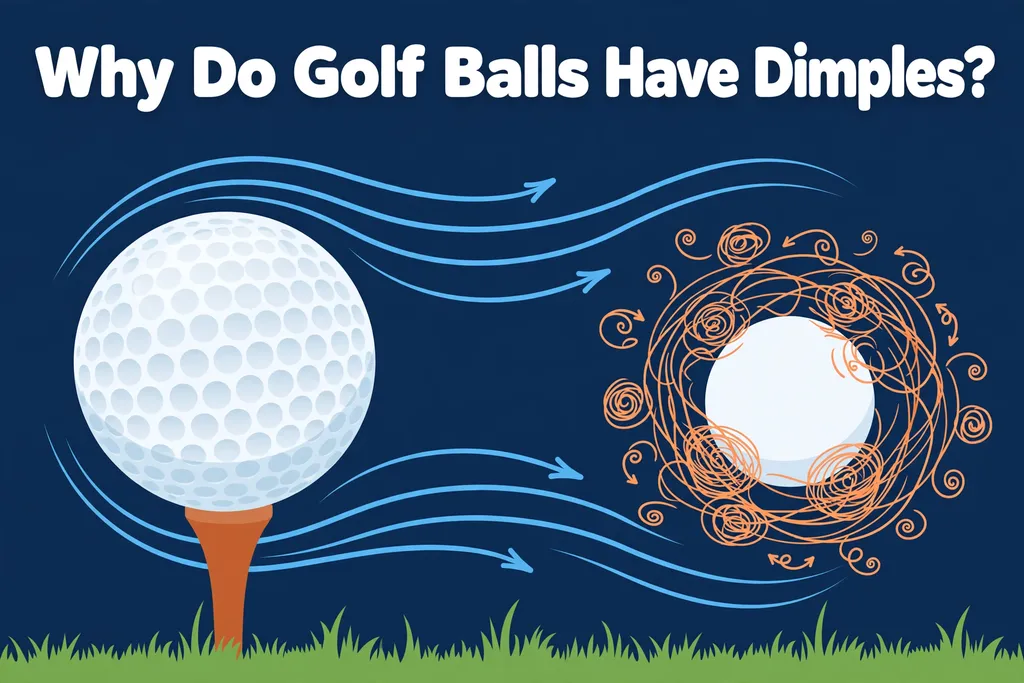
As a ball flies, it shoves air aside, and the air has to close back in behind it. On a smooth ball, the airflow gives up early: it separates from the surface about halfway around, leaving a wide, chaotic, low-pressure wake behind the ball. That wake acts like a vacuum tugging backwards — a force engineers call pressure drag. A smooth golf ball struck by a driver would travel only about 130 yards: the wake eats the rest.
What Dimples Do: Trip the Air on Purpose
Dimples rough up the thin layer of air — the boundary layer — right at the ball's surface, stirring it into turbulence. Counter-intuitively, turbulent air is stickier: it has more energy, clings to the curving surface longer, and separates much later. The wake shrinks to a fraction of its former size, and with it the backward tug. The net result, confirmed by the USGA's own equipment research: a dimpled ball has roughly half the drag of a smooth one and flies nearly twice as far. The dimples do not push the ball — they stop the air from holding it back.
The Other Half: Spin and Lift
Drag is only half the story. A well-struck drive leaves the club with heavy backspin, and that spin, working with the dimpled surface, generates lift through the Magnus effect — the ball effectively climbs on the air as it flies. Roughly half the lift that keeps a drive aloft comes from this spin interaction. Dimples make both halves work: less drag slowing the ball, and a stable spinning flight that holds its line.
How Golfers Discovered It: The Gutty Era
Nobody designed this in a lab. Early golf balls were wood, then leather pouches stuffed with boiled feathers ("featheries"), and in 1848 the game switched to solid balls moulded from gutta-percha, a tree sap — the smooth "gutty." Players soon noticed something odd: a gutty that was nicked and scuffed from play out-flew a pristine new one. Makers took the hint and began hammering deliberate patterns into the surface. In 1905, Englishman William Taylor patented the recognizably modern dimple pattern, and the smooth golf ball was extinct for good.
The Numbers on a Modern Ball
A typical modern ball carries between 300 and 500 dimples, each only about a hundredth of an inch deep — Titleist's Pro V1 uses 352, its sibling Pro V1x 328, and engineers tune count, size, and shape the way car designers tune spoilers. Dimples are not even required to be round: hexagonal dimples have been sold, promising still-slicker airflow. What has not changed since 1905 is the principle — controlled roughness beats smoothness, every single time.
Quick Summary
Golf balls have dimples because dimples stir the air at the surface into a turbulent boundary layer that clings longer, shrinks the drag-producing wake behind the ball, and — combined with backspin — generates lift. The result is about half the drag and nearly twice the distance of a smooth ball. Golfers found this out by accident in the gutty era, when scuffed balls out-flew new ones; the modern dimple was patented in 1905.
Frequently Asked Questions
How many dimples are on a golf ball?
Typically between 300 and 500, each about 0.010 inches deep. Popular models sit in the low-to-mid 300s — the Titleist Pro V1 has 352 — and manufacturers tune the pattern for each ball's intended flight.
How far would a smooth golf ball go?
Only about half as far as a dimpled one. The smooth ball's airflow separates early, creating a large low-pressure wake that drags it backwards; a drive that would carry 260 yards might manage roughly 130.
Who invented the golf ball dimple?
Golfers discovered the effect accidentally in the 1800s, when nicked gutta-percha balls flew farther than smooth new ones. William Taylor patented the modern dimple pattern in 1905.
Do dimples affect anything besides distance?
Yes — they stabilize flight. By shaping the airflow and working with the ball's spin, the dimple pattern influences height, direction, and how the ball behaves in wind. That is why different models use different patterns for different kinds of players.
Related Guides
- Why Are School Buses Yellow? The 1939 Decision That Stuck
- Why Do We Say Bless You When Someone Sneezes? 4 Surprising Origins
- 7 Bizarre Historical Facts You Probably Never Learned
External Resources
More in Other Curiosities

Why Are School Buses Yellow? The 1939 Decision That Stuck
Why Are School Buses Yellow? The 1939 Decision That Stuck Every school bus in North America wears the same shade — not just yellow, but one specific yellow-orange with its own official name. Nobody's…

Why Do We Say Bless You When Someone Sneezes? 4 Surprising Origins
Why Do We Say Bless You When Someone Sneezes? 4 Surprising Origins Sneeze in an elevator and a stranger will bless you automatically, without thinking. Cough in the same elevator and you will get…
7 Unusual Historical Inventions You Won’t Believe Existed
Unusual historical inventions give us a fascinating glimpse into the past—where human creativity often met eccentricity head-on. From strange beauty contraptions to dangerous early machines, these…