
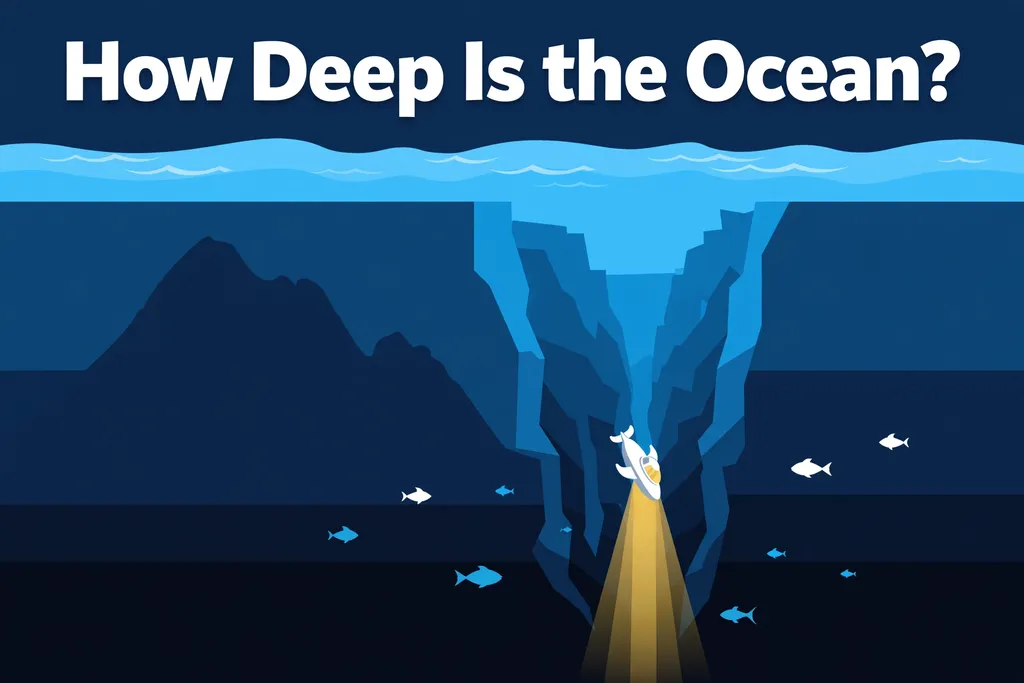
How Deep Is the Ocean? The Mariana Trench, Everest, and 6 Mind-Bending Facts
The ocean looks flat and calm from a beach, but below the surface it hides the most extreme landscape on Earth — canyons deeper than any mountain is tall. So how deep is the ocean? The deepest point ever measured would swallow Mount Everest whole and still leave more than a mile of water above its peak. Here is the descent, layer by layer.
The Deepest Point: The Challenger Deep
The deepest known place in the ocean is the Challenger Deep, at the southern end of the Mariana Trench in the western Pacific, near Guam. Modern measurements put it at about 10,935 metres (35,876 feet) below sea level — a figure refined by high-resolution mapping in 2020 to within a few metres. The trench itself runs for roughly 2,550 kilometres, carved where one tectonic plate dives beneath another.
Fact 1: Everest Would Drown
Mount Everest rises 8,849 metres above sea level. Lower it gently into the Challenger Deep and its summit would still be roughly 2,000 metres underwater — more than a mile of ocean above the highest point on land. The trench is not slightly deeper than Everest is tall; it is deeper by almost a quarter.
Fact 2: The Average Ocean Is 3,688 Metres Deep
The Challenger Deep is the extreme. The average depth of the world's oceans is about 3,688 metres (12,100 feet) — still deep enough to submerge most mountain ranges, and a reminder that the "solid ground" continents are the exception on this planet, not the rule. Translated to volume: the oceans hold about 1.3 billion cubic kilometres of water.
Fact 3: The Pressure Would Crush Almost Anything
Water is heavy, and pressure grows by roughly one atmosphere every 10 metres you descend. At the bottom of the Challenger Deep, the pressure exceeds 1,000 times the pressure at the surface — like balancing dozens of elephants on a thumbnail. It is why only a handful of specially built submersibles have ever made the trip, and why their viewports are small, thick cones of acrylic and steel.
Fact 4: Almost Nobody Has Been There
The first descent was in 1960, when Jacques Piccard and Don Walsh rode the bathyscaphe Trieste to the bottom and stayed about 20 minutes. The world then waited 52 years for the next visitor: filmmaker James Cameron's solo dive in 2012. More people have stood on the Moon than on the floor of the Challenger Deep.
Fact 5: The Ocean Is Layered Like an Atmosphere
Oceanographers divide the descent into zones. The sunlit epipelagic zone (0–200 m) holds nearly all ocean life you know. Below it, the twilight zone fades to black by 1,000 m. Then come the midnight zone, the abyssal zone (down to 6,000 m), and finally the hadal zone — named for Hades — inside the trenches, where the Challenger Deep waits in total darkness at near-freezing temperatures.
Fact 6: There Is Life at the Very Bottom
Even at crushing pressure and near 1°C, the trench is not empty. Expeditions have found amphipods (shrimp-like crustaceans), sea cucumbers, and single-celled giants called xenophyophores on the trench floor, and fish — snailfish — have been filmed deeper than 8,000 metres, the deepest fish ever recorded. Life, it turns out, is as stubborn as the geology.
Quick Summary
The ocean's deepest point, the Challenger Deep in the Mariana Trench, lies about 10,935 metres down — enough to drown Mount Everest with room to spare. The average ocean depth is 3,688 metres, the pressure at the bottom tops 1,000 atmospheres, and fewer people have visited the bottom than have walked on the Moon — yet even down there, life carries on.
Frequently Asked Questions
What is the deepest part of the ocean?
The Challenger Deep, in the Mariana Trench of the western Pacific Ocean. It is measured at roughly 10,935 metres (35,876 feet) below sea level, the deepest known point on the seabed.
Could Mount Everest fit in the Mariana Trench?
Easily. Everest is 8,849 metres tall; the Challenger Deep is about 10,935 metres deep. The summit would remain around 2,000 metres — over a mile — below the surface.
Has anyone been to the bottom of the ocean?
Yes, but very few. Jacques Piccard and Don Walsh were first in 1960 aboard the Trieste; James Cameron made a solo dive in 2012, and a small number of expeditions have followed since.
Is there life at the bottom of the Mariana Trench?
Yes. Cameras and landers have recorded amphipods, sea cucumbers, xenophyophores, and snailfish living under pressures more than 1,000 times greater than at the surface.
Related Guides
- Why Is the Ocean Salty? 6 Fascinating Facts About the Sea
- Why Is the Sky Blue? The Science of Rayleigh Scattering
- How Earth Formed: From Stardust to a Living Planet
External Resources
More in Facts & Explanations
Why Is the Ocean Salty? 6 Fascinating Facts About the Sea
Why Is the Ocean Salty? 6 Fascinating Facts About the Sea Swallow a mouthful of river water and it tastes like nothing. Swallow a mouthful of seawater and you will never forget it. Yet the same rain…
Why Do We Always See the Same Side of the Moon? 7 Fascinating Facts About Tidal Locking
Why Do We Always See the Same Side of the Moon? 7 Fascinating Facts About Tidal Locking Look up at a full Moon tonight, and you are seeing the exact same view your grandparents saw — and the same one…

What Is Quantum Computing: 5 Incredible Ways It’s Changing the Future
What is quantum computing ? It’s one of the most revolutionary advancements in modern science — a new way of processing information that could transform how we solve problems, secure data, and…