
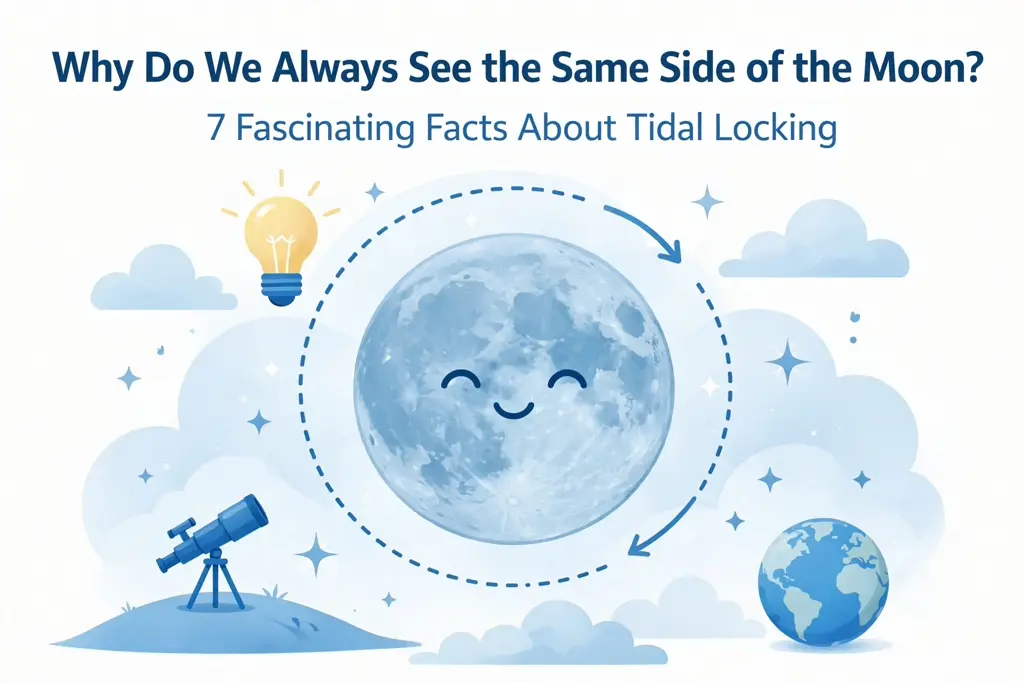
Why Do We Always See the Same Side of the Moon? 7 Fascinating Facts About Tidal Locking
Look up at a full Moon tonight, and you are seeing the exact same view your grandparents saw — and the same one people saw thousands of years ago. The craters never move, the dark patches never shift, and no matter where on Earth you stand, the Moon always shows you one familiar face. Yet the Moon is spinning the whole time. Understanding why we always see the same side of the Moon reveals one of the most elegant balancing acts in the solar system: a gravitational partnership billions of years in the making.
Watch: The Same Side of the Moon, Explained in 20 Seconds
The Short Answer
The Moon does rotate — it spins once on its axis every 27.3 days. It also takes exactly 27.3 days to travel once around Earth. Because the spin and the orbit take the same time, the same half of the Moon is always turned toward us. Astronomers call this synchronous rotation, and it is the result of a process called tidal locking.
Picture walking slowly in a circle around a friend while always facing them. By the time you finish one lap, you have also turned your body exactly once — anyone watching would say you "rotated," even though your friend only ever saw your face. That is precisely what the Moon does on every lap around Earth.
7 Fascinating Facts About Tidal Locking
1. The Moon's Day and Its Orbit Are the Same Length
One full spin of the Moon takes 27.3 days, and one full orbit of Earth takes 27.3 days. The match is so exact that a single lunar "day" — sunrise to sunrise at a spot on the Moon's surface — lasts about 29.5 Earth days, because the Sun's position shifts as the Earth–Moon system travels together. The key point is the lockstep: spin period equals orbital period, so the geometry between Earth and the Moon's surface never changes.
2. The Moon Used to Spin Much Faster
The match was not always there. When the Moon was young — and much closer to Earth — it spun far faster, and every side of it was visible from Earth over time. Earth's gravity raised tides in the Moon's body, creating bulges. Because the Moon was spinning, those bulges kept getting carried slightly ahead, and Earth's gravity pulling back on them acted like a gentle brake. Over billions of years, that brake slowed the Moon's spin until it settled at exactly one rotation per orbit — the most stable arrangement, which is why it has stayed locked ever since.
3. The Far Side Is Not the Dark Side
The half we never see is called the far side, not the dark side — it receives exactly as much sunlight as the near side. During a new Moon, the far side is actually in full daylight. "Dark" only ever meant unknown: no human saw the far side until the Soviet spacecraft Luna 3 photographed it on October 7, 1959. The photos surprised scientists — the far side is far more heavily cratered and has very few of the dark lava plains, called maria, that form the familiar "face" on the side we see.
4. We Actually See About 59% of the Moon
"Same side" is very slightly approximate. The Moon's orbit is an ellipse, so its orbital speed changes while its spin stays steady, and its axis is tilted a little. The combination produces a gentle wobble called libration. Thanks to that wobble, patient observers can peek around the Moon's edges at different times of the month, and over a full cycle about 59% of the surface becomes visible from Earth — even though only one face is ever pointed at us at any given moment.
5. The Lock Is Still Slowly Changing
Tidal locking is not finished. The same tidal braking that locked the Moon is still transferring spin energy from Earth to the Moon's orbit, which pushes the Moon about 3.8 centimetres farther away every year. We know this precisely because Apollo astronauts left laser reflectors on the surface, and scientists still bounce laser pulses off them to measure the distance. In exchange, Earth's own rotation is slowing by roughly two milliseconds per century — our days are, very gradually, getting longer.
6. Earth Is Being Locked Back — But It Will Never Finish
The process runs both ways. The Moon's gravity raises tides on Earth and brakes our spin, so given unlimited time, Earth's day would stretch until it matched the Moon's orbit — about 47 of today's days — and each world would permanently show the other one face, the way the Moon already does for us. In practice it will never get there: locking Earth completely would take tens of billions of years, and the Sun will swell into a red giant in about five billion years, long before the lock can close.
7. The Moon Is Not Special — This Happens Everywhere
Tidal locking is one of the most common arrangements in the solar system. All four of Jupiter's large Galilean moons — Io, Europa, Ganymede, and Callisto — are tidally locked to Jupiter, and most large moons in the solar system are locked to their planets the same way. The most perfectly matched pair is Pluto and its moon Charon: they are locked to each other, both keeping the same face toward the other forever, like two dancers who never turn away.
Quick Summary
We always see the same side of the Moon because its spin and its orbit take the same time — 27.3 days each — after Earth's gravity spent billions of years braking the Moon's faster early spin into lockstep, a process called tidal locking. The hidden far side is not dark, a slight wobble called libration lets us glimpse about 59% of the surface over a month, and the Moon is still drifting 3.8 cm farther away each year as the tidal exchange continues.
Frequently Asked Questions
Does the Moon rotate at all?
Yes — it rotates once every 27.3 days. That rotation is exactly why the same side faces us. If the Moon did not rotate, we would see all of its sides over the course of one orbit, the way you see every side of a statue by walking around it.
Is the far side of the Moon really dark?
No. The far side gets just as much sunlight as the side we see — during a new Moon it is fully lit. It was called "dark" only because it stayed unknown until Luna 3 photographed it in 1959.
What is the far side of the Moon like?
It is rougher and more heavily cratered than the near side, with far fewer of the smooth dark lava plains (maria) that make the pattern we recognize. Why the two sides differ so much is still an active research question. Landers have visited it — China's Chang'e 4 made the first soft landing on the far side in 2019.
Is the Moon moving away from Earth?
Yes, by about 3.8 centimetres per year, measured by laser ranging to reflectors left on the surface by Apollo missions. The distance grows because Earth's spin energy is slowly being transferred to the Moon's orbit through the tides.
Related Guides
- What Are Black Holes: 7 Astonishing Facts About Space
- What Is a Supernova: 7 Incredible Defining Characteristics
- What Is Quantum Computing: 5 Incredible Ways It’s the Future
External Resources
More in Facts & Explanations
How Deep Is the Ocean? The Mariana Trench, Everest, and 6 Mind-Bending Facts
How Deep Is the Ocean? The Mariana Trench, Everest, and 6 Mind-Bending Facts The ocean looks flat and calm from a beach, but below the surface it hides the most extreme landscape on Earth — canyons…
Why Is the Ocean Salty? 6 Fascinating Facts About the Sea
Why Is the Ocean Salty? 6 Fascinating Facts About the Sea Swallow a mouthful of river water and it tastes like nothing. Swallow a mouthful of seawater and you will never forget it. Yet the same rain…
What Is Quantum Computing: 5 Incredible Ways It’s Changing the Future
What is quantum computing ? It’s one of the most revolutionary advancements in modern science — a new way of processing information that could transform how we solve problems, secure data, and…