
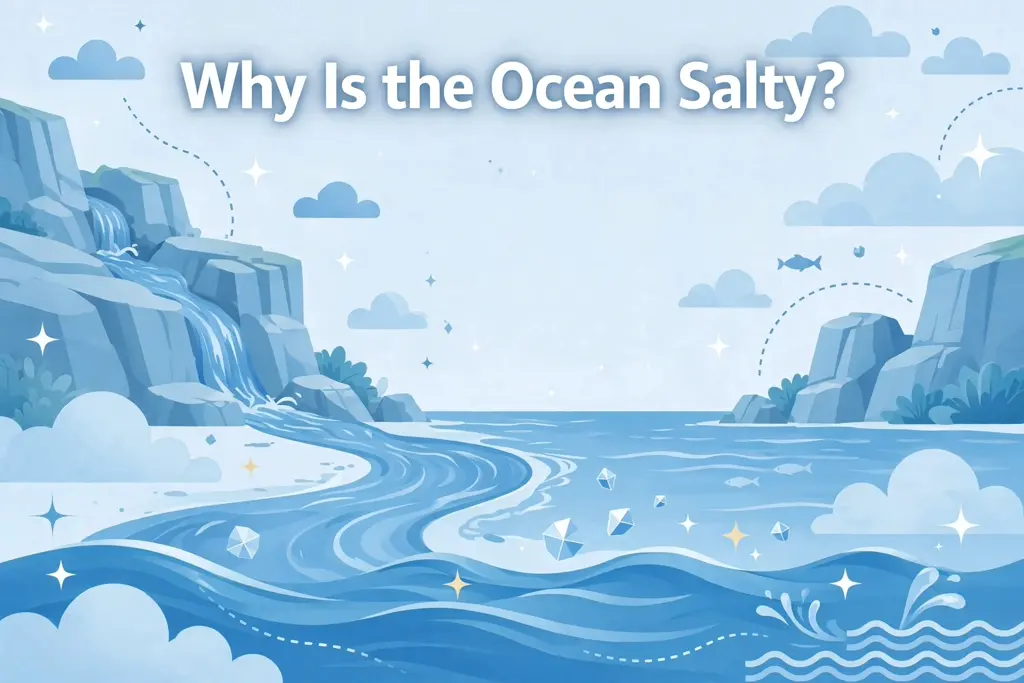
Why Is the Ocean Salty? 6 Fascinating Facts About the Sea
Swallow a mouthful of river water and it tastes like nothing. Swallow a mouthful of seawater and you will never forget it. Yet the same rain falls on both, and every river on Earth eventually empties into the sea. So why is the ocean salty when the water flowing into it is fresh? The answer is a slow-motion process that has been running for billions of years — and it explains a few surprising things about lakes, too.
The Short Answer
Rain washes tiny amounts of dissolved minerals out of rocks and soil, rivers carry those minerals to the ocean, and the ocean keeps them. When seawater evaporates, only the water leaves — the salt stays behind. Repeat that cycle for a few billion years and you get an ocean that is about 3.5% salt, fed by rivers too dilute to taste salty at all.
6 Fascinating Facts About Ocean Salt
1. It Starts With Rain Falling on Rock
Rainwater is very slightly acidic, because it absorbs a little carbon dioxide from the air on the way down. That weak acid is enough to slowly dissolve minerals out of exposed rock — a process called weathering. The two most common dissolved ingredients are sodium and chloride ions, and when those two meet in the sea, they form sodium chloride: ordinary table salt. Every stream you have ever seen is quietly carrying a dissolved cargo of rock toward the ocean.
2. Rivers Deliver Billions of Tons of Salt Every Year
The quantities are hard to picture. According to NOAA, the world's rivers carry an estimated four billion tons of dissolved salts to the ocean annually — rivers flowing from the United States alone discharge about 225 million tons of dissolved solids a year. You cannot taste it in river water because it is spread so thin, but the ocean collects the delivery from every river, everywhere, with no return address.
3. Evaporation Is the Concentrator
The ocean has no outlet. Water leaves it mainly by evaporation, and evaporation is picky: it lifts pure water vapor into the sky and leaves every grain of dissolved salt behind. That vapor later falls as rain, runs over rock, picks up a fresh whisper of minerals, and delivers them to the sea again. The ocean is like a pot that has been topped up with very slightly salted water for billions of years while steam escaped — the pot inevitably gets saltier than any single refill.
4. The Seafloor Adds Salt of Its Own
Rivers are not the only source. Deep under the ocean, seawater seeps into cracks in the crust, is heated by magma, reacts with the surrounding rock, and blasts back out through hydrothermal vents loaded with minerals. Underwater volcanoes contribute as well. NOAA points to these openings in the seafloor as the ocean's second salt supply — the sea is being seasoned from below as well as from the land.
5. Lakes Stay Fresh Because They Drain
Most lakes are a pass-through, not a dead end: water flows in from rivers and flows out again, carrying dissolved minerals with it before they can build up. That is why lake water tastes fresh even though the same weathering happens on its shores. The exceptions prove the rule. Lakes with no outlet, like Utah's Great Salt Lake and the Dead Sea, lose water only by evaporation — exactly like the ocean — and both are far saltier than the sea itself.
6. The Ocean Probably Is Not Getting Saltier Anymore
After billions of years, the system appears to have reached a balance. Roughly as much salt as arrives each year is removed — buried in seafloor sediments and locked into new rock — so, in NOAA's assessment, yearly gains roughly offset yearly losses. The primeval seas were probably only slightly salty; today's 3.5% ocean is less a work in progress than a finished equilibrium.
Quick Summary
The ocean is salty because slightly acidic rain dissolves minerals from rock, rivers deliver an estimated four billion tons of dissolved salts to the sea each year, and evaporation removes only pure water, leaving the salt behind. The seafloor adds more minerals through hydrothermal vents. Lakes stay fresh because they drain; lakes that cannot drain, like the Dead Sea, turn saltier than the ocean. After billions of years the ocean's salt level has roughly balanced out.
Frequently Asked Questions
How salty is the ocean, exactly?
On average, seawater is about 3.5% salt — roughly 35 grams of salt in every litre of water. Salinity varies a little by location: it is lower near river mouths and melting ice, and higher in hot, enclosed seas where evaporation is intense.
Why aren't rivers salty if they carry salt?
Because river water never sits still. Rain constantly replenishes rivers with fresh water, and the flow carries its tiny mineral load straight through to the sea. The salt is there — just far too dilute to taste.
Is every ocean the same saltiness?
No. Salinity depends on the local balance of evaporation, rainfall, river inflow, and freezing or melting ice. Sheltered, sunny seas tend to be saltier, while coastal waters near big rivers are noticeably fresher at the surface.
Could the ocean ever become fresh again?
Not through any natural process we know of. As long as rain weathers rock and evaporation leaves salt behind, the ocean stays salty — the cycle that built its salt is still running every day.
Related Guides
- Why the Sky Is Blue: 5 Fascinating Facts
- How Earth Formed: 5 Incredible Stages That Shaped Our Planet
- Why Do We Always See the Same Side of the Moon? 7 Fascinating Facts About Tidal Locking
External Resources
More in Facts & Explanations
How Deep Is the Ocean? The Mariana Trench, Everest, and 6 Mind-Bending Facts
How Deep Is the Ocean? The Mariana Trench, Everest, and 6 Mind-Bending Facts The ocean looks flat and calm from a beach, but below the surface it hides the most extreme landscape on Earth — canyons…
Why Do We Always See the Same Side of the Moon? 7 Fascinating Facts About Tidal Locking
Why Do We Always See the Same Side of the Moon? 7 Fascinating Facts About Tidal Locking Look up at a full Moon tonight, and you are seeing the exact same view your grandparents saw — and the same one…
What Is Quantum Computing: 5 Incredible Ways It’s Changing the Future
What is quantum computing ? It’s one of the most revolutionary advancements in modern science — a new way of processing information that could transform how we solve problems, secure data, and…