
How to Get Rid of Fruit Flies: 6 Methods That Actually Work
One forgotten banana on Monday can mean a cloud of tiny flies by Friday. Fruit flies seem to materialize from nowhere because their life cycle is brutally fast: a single female lays hundreds of eggs on fermenting produce, and in a warm kitchen the trip from egg to adult takes about a week. Killing the flies you see is the easy part. Here is how to get rid of fruit flies for good — by ending the breeding cycle, not just swatting at it.
First, Make Sure They Are Fruit Flies
Three different pests get called "fruit flies," and each needs a different fix. Fruit flies are small and tan or brown, often with red eyes, and hover around produce, bins, and counters. Drain flies are fuzzy and moth-like, rest on walls near sinks, and breed in the slime inside drains. Fungus gnats are dark and long-legged and live in damp houseplant soil. A quick test: tape clear tape sticky-side-down over a suspect drain overnight. Moth-like flies on the tape in the morning means drain flies — skip to Method 4. If your flies swarm the fruit bowl instead, start at Method 1.
6 Methods That Actually Work
1. Remove the Breeding Source
This is the method that actually ends infestations. Throw out overripe and rotting produce, check the forgotten potato or onion at the back of the cupboard, empty compost and recycling, rinse cans and bottles before they go in the bin, and look under appliances for spilled juice. A trap can catch adults all week, but one rotting peach will replace them faster than you can catch them.
2. Set the Apple Cider Vinegar Trap
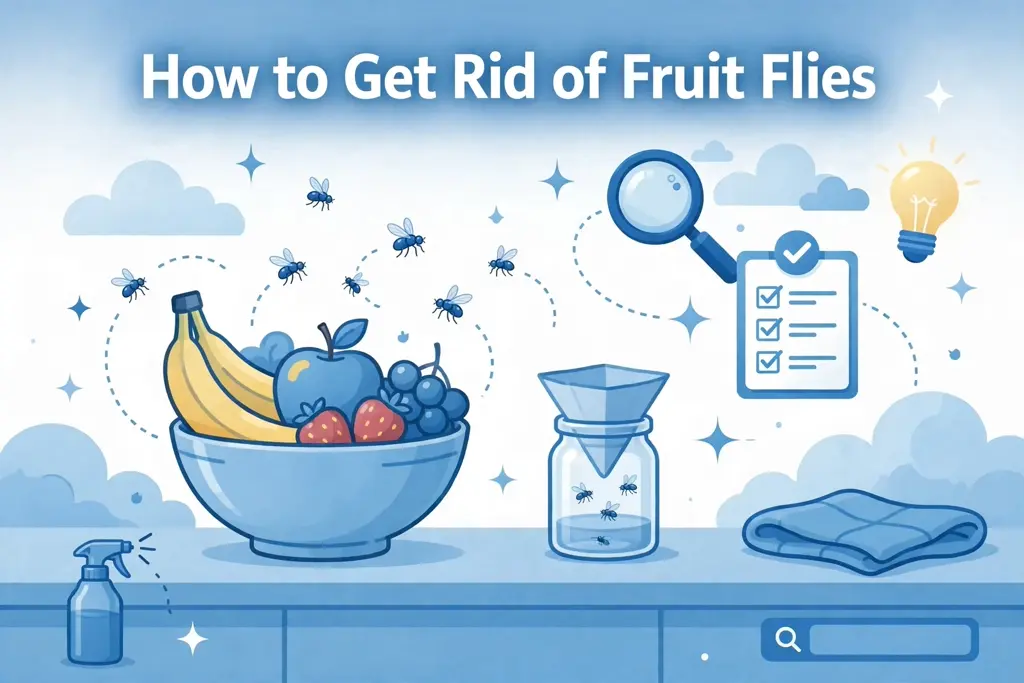
Pour about a quarter cup of apple cider vinegar into a small jar, add a few drops of dish soap, and leave it open near the activity. The vinegar smells like fermenting fruit — irresistible — and the soap breaks the surface tension, so flies that land to drink sink instead of skating away. A paper funnel or plastic wrap poked with small holes makes escape harder. Set out several traps and refresh them every few days. Expect heavy catches within 48 hours.
3. Cut Off the Food Supply
Until the swarm is gone, keep ripe fruit in the fridge instead of on the counter, take kitchen trash out daily, and seal compost. Fruit flies are drawn to fermentation — an open bottle of wine, a splash of beer in a glass, or vinegar itself can all feed the problem. You are not just cleaning; you are removing every nursery and restaurant at once.
4. Scrub the Drains
If the tape test pointed to drain flies — or if flies persist with no produce in sight — the nursery is the gelatinous biofilm inside your drains. Scrub it physically with a stiff drain brush, flush with boiling water, and follow with an enzyme-based drain cleaner that digests organic slime. Bleach and hot water alone tend to wash over the film without removing it; the scrubbing is what works. Repeat a few times a week until the flies stop appearing.
5. Wipe Down and Dry Everything
Sticky spills, damp sponges, mop buckets with standing water, and the drip tray under the fridge all give fruit flies moisture and food. Wipe counters daily during an infestation, wring out sponges, and keep sink areas dry overnight. It sounds minor, but eggs are laid in exactly these overlooked wet films of residue.
6. Keep Them Out Next Time
Check window screens for gaps, store produce properly from the day it comes home, rinse recycling as you go, and give drains a brush and a boiling-water flush every week or two. Homes that run these small habits rarely see a swarm at all — prevention is mostly about never offering a breeding site.
How Long Until They Are Gone?
With the source removed and traps running, most infestations collapse within one to two weeks — one full life cycle. If flies are still going strong after two weeks, there is a hidden source you have not found yet: a drain, a mop bucket, a bag of onions, or something fermenting behind or under an appliance. Persistence is a clue, not a failure.
Quick Summary
To get rid of fruit flies, remove what they breed in — overripe produce and hidden fermenting residue — then trap the adults with apple cider vinegar plus a few drops of dish soap to break the surface tension. If the flies are fuzzy and gather at drains, they are drain flies: scrub the biofilm out of the pipes instead. Most infestations end within one to two weeks once the breeding source is gone.
Frequently Asked Questions
Why do I have fruit flies when there is no fruit out?
Because fruit is only one nursery. Drains with organic buildup, recycling with residue, mop buckets, compost containers, and spills under appliances all breed fruit flies. If there is no produce, suspect the drains first.
Does the vinegar trap work by itself?
No — traps only catch adults. As long as a breeding source exists, new flies hatch daily and replace them. The trap is a mop-up tool; removing the source is the cure.
How can I tell fruit flies from drain flies?
Fruit flies are tan or brown, often red-eyed, and hover around food and counters. Drain flies are fuzzy, moth-like, weaker fliers that rest on walls near drains. The tape-over-the-drain overnight test settles it.
Are fruit flies dangerous?
They are mostly a nuisance, but they wander between drains, trash, and your food, and can carry bacteria from surface to surface as they go. Another good reason to end the breeding cycle rather than live with them.
Related Guides
- Get Rid of Ants in Your Kitchen: 5 Easy and Natural Ways
- 7 Simple Effective Ways to Unclog a Slow-Draining Bathroom Sink
- Fix a Leaky Kitchen Faucet in 5 Powerful Easy Steps
External Resources
More in How-To & Fixes

How to Remove Permanent Marker from Almost Anything: 6 Methods by Surface
How to Remove Permanent Marker from Almost Anything: 6 Methods by Surface Here is the secret the name hides: permanent marker is only permanent against water. Its ink is pigment locked in a resin…

Why Does My Smoke Detector Keep Chirping? 5 Causes and the Fixes
Why Does My Smoke Detector Keep Chirping? 5 Causes and the Fixes It never starts at noon. It starts at 3 a.m. — one chirp, every minute or so, from a detector you cannot quite locate in the dark. Why…

7 Simple Ways to Unclog a Slow-Draining Bathroom Sink (Fast & Safe)
Need to unclog a slow-draining bathroom sink? This guide walks you through fast, safe methods—from boiling water to cleaning the P-trap—so you can restore flow without calling a plumber. Whether the…