
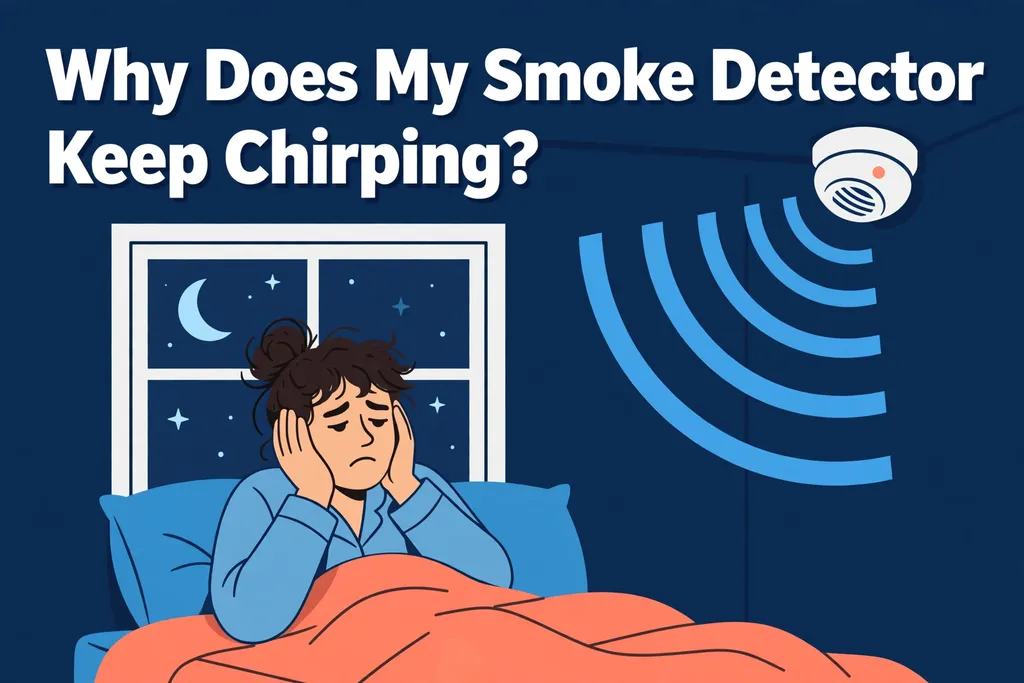
Why Does My Smoke Detector Keep Chirping? 5 Causes and the Fixes
It never starts at noon. It starts at 3 a.m. — one chirp, every minute or so, from a detector you cannot quite locate in the dark. Why does my smoke detector keep chirping? Because it is trying to tell you something specific. A chirp is a maintenance message with five common meanings, and each one has a different fix. Here they are, in the order you should check them.
Watch: The 3 A.M. Chirp, Explained in 20 Seconds
Cause 1: A Low Battery (the Usual Suspect)
A single chirp every 30 to 60 seconds is, most of the time, the low-battery warning. Replace the battery with a fresh one of the correct type — and do not just press the hush button and go back to bed, because on many models the silence is only temporary. Hardwired detectors chirp for this too: they run on house power but carry a backup battery, and it is the backup that dies. One more thing worth knowing: manufacturers still recommend replacing replaceable batteries at least once a year, whether the detector has complained or not.
Cause 2: The Detector Has Expired
This is the cause nobody expects: smoke detectors wear out. The National Fire Protection Association (NFPA) recommends replacing every smoke alarm 10 years after its date of manufacture, because the sensor degrades with age and exposure. Twist the unit off its base and read the date stamped on the back — that date, not when you moved in or installed it, starts the clock. An expired detector often keeps chirping even with a brand-new battery: that persistent, sometimes faster or triple-chirp pattern is its end-of-life signal, and no battery will fix it. A detector whose plastic has yellowed is another tell — that tint generally means it is past the decade mark. Replace the whole unit.
Cause 3: Dust and Insects in the Sensor
The sensing chamber is an open invitation to dust, and occasionally to a spider. Debris inside can scatter the sensor's beam and trigger chirps and false alarms. The fix is housekeeping: vacuum around the vents with a soft brush attachment, or blow the unit out gently with compressed air, every six months or so. If a detector near a kitchen or garage chirps while looking dusty, clean it before you condemn it.
Cause 4: Steam, Humidity, and Bad Placement
A detector mounted too close to a bathroom or kitchen lives in a world of shower steam and cooking fumes, both of which can disturb the sensor and provoke chirps and nuisance alarms. The guidance is to install alarms at least 10 feet from kitchens and bathrooms where possible. If yours sits right outside a steamy bathroom door, relocation — not another battery — is the permanent cure.
Cause 5: A Power Glitch (Hardwired Units)
On hardwired systems, a power surge, a brief outage, or a loose connection can leave a detector in a fault state, chirping at random. Try a full reset: remove the battery (and, for hardwired units, cut power at the breaker), then press and hold the test button for about 15–20 seconds to drain the residual charge. Reinstall the battery, restore power, and test the alarm. If the chirping returns on a unit that is under 10 years old with a fresh battery and a clean sensor, the detector itself has likely failed — replace it.
Why Does It Always Start at 3 A.M.?
There is a real reason the chirp seems to save itself for the middle of the night. Batteries lose a little voltage as temperatures fall, and houses are coolest in the small hours — so a battery that is merely weak during the warm day can dip below the warning threshold at 3 a.m. and start the chorus. The detector is not being dramatic; the night is simply when a dying battery crosses the line. And never solve it by pulling the battery out and leaving it out: a silent, dead detector is the one outcome worse than the noise.
Quick Summary
A chirping smoke detector means one of five things: a low battery (chirp every 30–60 seconds — replace it), an expired unit (NFPA: replace 10 years from the manufacture date on the back), dust or insects in the sensor (vacuum or blow it out), steam and bad placement, or a power glitch (full reset: remove power, hold the test button 15–20 seconds). Test alarms monthly, and never leave a detector battery-less.
Frequently Asked Questions
Why is my smoke detector chirping after I changed the battery?
Usually one of three things: the unit has reached its 10-year end of life (check the manufacture date on the back), it needs a reset to clear the fault (remove the battery, hold the test button 15–20 seconds, reinstall), or the new battery is weak or the wrong type.
How long do smoke detectors last?
About 10 years from the date of manufacture, per the NFPA — after that, sensor reliability drops and the whole unit should be replaced, not just its battery. Carbon monoxide alarms typically last 7–10 years.
How do I stop the chirping right now?
Most models have a hush button that silences a low-battery chirp temporarily, which buys you time to get a battery in the morning. But treat it as a snooze, not a solution — and never remove the battery and leave the detector dead.
How often should I test my smoke detectors?
Monthly, using the test button, per NFPA guidance. Clean them about every six months, replace batteries at least yearly (unless sealed 10-year models), and replace the entire unit at 10 years.
Related Guides
- How to Get Rid of Fruit Flies: 6 Methods That Actually Work
- 7 Simple Effective Ways to Unclog a Slow-Draining Bathroom Sink
- Fix a Leaky Kitchen Faucet in 5 Powerful Easy Steps
External Resources
More in How-To & Fixes
How to Remove Permanent Marker from Almost Anything: 6 Methods by Surface
How to Remove Permanent Marker from Almost Anything: 6 Methods by Surface Here is the secret the name hides: permanent marker is only permanent against water. Its ink is pigment locked in a resin…

How to Get Rid of Fruit Flies: 6 Methods That Actually Work
How to Get Rid of Fruit Flies: 6 Methods That Actually Work One forgotten banana on Monday can mean a cloud of tiny flies by Friday. Fruit flies seem to materialize from nowhere because their life…

7 Simple Ways to Unclog a Slow-Draining Bathroom Sink (Fast & Safe)
Need to unclog a slow-draining bathroom sink? This guide walks you through fast, safe methods—from boiling water to cleaning the P-trap—so you can restore flow without calling a plumber. Whether the…