
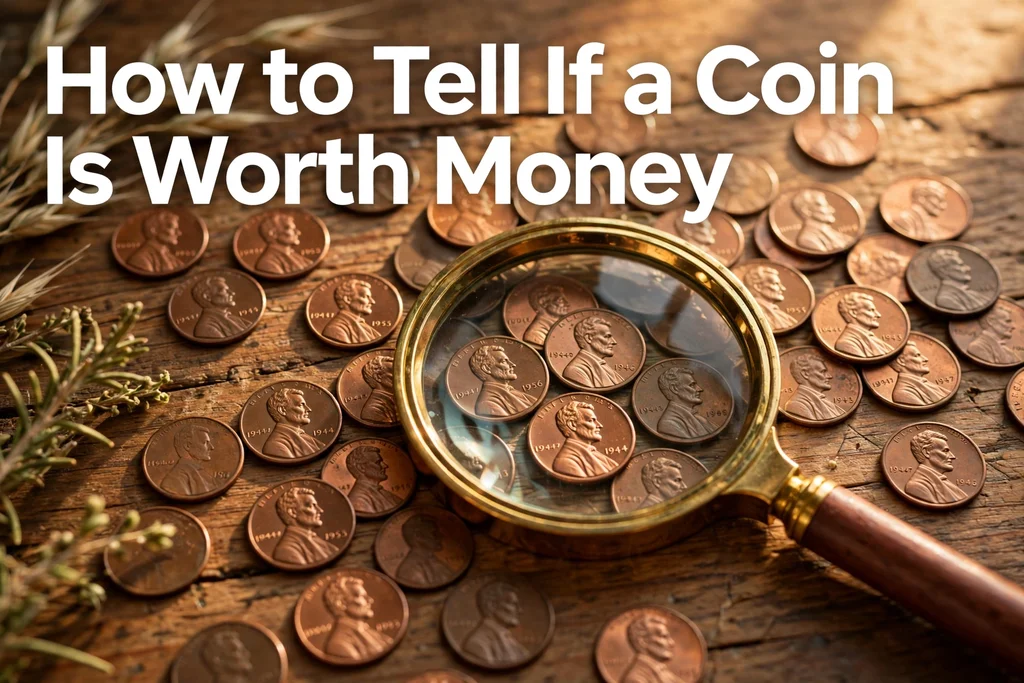
How to Tell If a Coin Is Worth Money: 7 Checks Before You Spend It
Every so often, a coin that looks like ordinary pocket change turns out to be worth a small fortune. The most famous example is the 1943 copper penny: during the Second World War, the U.S. Mint struck pennies in zinc-coated steel to save copper for the war effort, but a handful of leftover bronze planchets were accidentally struck with the 1943 date. Only about 20 to 30 are known to exist, and the finest one — a 1943-D bronze cent — sold for $1.7 million in 2010. Most coins in your change jar are worth exactly their face value. But a few simple checks can tell you whether the one in your hand deserves a second look before it goes into a parking meter.
The same principle applies to the vinyl records and stamps we covered in earlier guides: value comes from rarity, condition, and demand, not age alone. A coin can be a hundred years old and still be worth a few cents, while a coin from 1969 can be worth tens of thousands. Here is how to tell the difference.
1. Check the Date First
The date is the fastest filter. Certain years are famous for errors and low mintages, and knowing them saves you from examining every coin in the jar. For U.S. pennies, the big ones are 1943 (the copper error), 1944 (the reverse error — a steel penny struck in 1944, worth $75,000 to $500,000 or more), 1955 (the doubled die), 1969-S (the doubled die), and 1909-S VDB (a low-mintage first-year Lincoln cent). For Canadian coins, the famous rarity is the 1936 dot cent, and Canada stopped distributing its penny in 2013, so every Canadian cent is now a piece of history — though most are still worth only a cent.
Do not stop at the famous years, though. Low-mintage dates exist in every series, and a coin's value often hinges on a year you would not expect. A quick search for the date and denomination — "1921 Morgan dollar value," for example — will tell you in seconds whether that year is ordinary or interesting.
2. Read the Mint Mark
The mint mark is the small letter that tells you where a coin was made, and it is often what turns a common year into a rare one. On U.S. coins, "S" stands for San Francisco, "D" for Denver, and no mint mark usually means Philadelphia. On Lincoln cents the mint mark sits just below the date. A 1909 penny from Philadelphia is common; a 1909-S VDB from San Francisco is a key date worth hundreds or thousands depending on condition. Always check the date and the mint mark together — one without the other tells you almost nothing.
3. Try the Magnet Test
This is the single most useful test for the famous 1943 penny, and it takes five seconds. A normal 1943 steel cent sticks hard to a magnet. A genuine 1943 copper penny does not stick at all. If your 1943 penny is copper-coloured and ignores a magnet, you may be holding something extraordinary — but be careful, because copper-plated steel fakes exist, and the steel core inside them still sticks to a magnet. The magnet test catches those. The same trick works in reverse: a 1944 penny that sticks to a magnet is the rare steel error, since 1944 pennies were supposed to be copper.
4. Weigh It
A pocket scale that reads to 0.01 grams separates the metals when your eyes cannot. A genuine bronze 1943 cent weighs 3.11 grams; a steel one weighs 2.7 grams; a copper-plated zinc cent weighs 2.5 grams. Weight is also the giveaway for many other wrong-metal errors, which are among the most valuable mistakes a mint can make. If a coin feels wrong in your hand — too light, too heavy, too thick — weigh it and compare it to the standard weight for its date. Published specifications for every major coin are freely available online.
5. Look for Doubling and Errors
Doubled dies are coins where the design appears stamped twice, and the strong ones are worth real money. The 1955 doubled die Lincoln cent shows dramatic doubling on the date and lettering, and even circulated examples start around $1,500. The 1969-S doubled die is rarer still: fewer than 100 genuine examples are known, and even heavily worn ones start around $10,000, with fine examples reaching six figures. The key detail on the 1969-S is that the doubling appears on the date and on "LIBERTY" and "IN GOD WE TRUST," but not on the S mint mark, because mint marks were punched into the die by hand after hubbing. If the S is doubled too, walk away — it is not genuine.
Use a magnifying glass or a loupe, and look at the lettering rather than the portrait. Genuine doubling is crisp and distinct; machine doubling, a common and nearly worthless effect, looks flat and shelf-like. When in doubt, compare your coin against verified photos of the real error before getting excited.
6. Judge the Condition Honestly — and Never Clean It
Condition moves every number. A coin that retains its original red lustre and has never circulated — mint state — can be worth many times more than the same coin with wear. Collectors grade on a scale from Poor to Mint State, and the difference between grades can be thousands of dollars on a rare date. Colour matters too: copper coins are graded Red, Red-Brown, or Brown, with Red commanding the highest prices.
Here is the rule that matters most: never clean a coin. Cleaning strips away the original surface, leaves hairline scratches, and destroys the toning collectors value. A cleaned rare coin can lose most of its value in a single afternoon. If a coin looks dirty, leave it dirty. A professional grading service can advise, but a bottle of polish and a cloth are the fastest way to turn a valuable coin into an ordinary one.
7. Know What the Metal Itself Is Worth
Even a common coin can carry metal value. U.S. pennies minted before 1982 are 95 percent copper, and their metal content is worth more than one cent. Silver coins — U.S. dimes, quarters, and half dollars from 1964 and earlier are 90 percent silver — are worth at least their melt value, which rises and falls with the silver price. That does not make every old coin valuable, but it does set a floor: a worn silver dime is never worth less than its silver. Check the current melt value before spending a pre-1965 silver coin as ten cents.
What to Do If You Think You Have Something
First, handle it by the edges and put it in a holder or a soft flip — fingerprints and pocket wear only reduce value. Second, verify it yourself with the tests above: date, mint mark, magnet, weight, and a careful look under magnification. Third, do not trust a single online listing; check completed auction results from reputable houses and price guides. Finally, if the signs point to a genuine rarity, have it authenticated by a major grading service such as PCGS or NGC. Authentication costs money, but for a coin that could be worth five or six figures, it is the step that separates a real find from an expensive disappointment — and it is also what protects you from the many counterfeits of the famous errors.
Quick Summary
A coin is worth more than face value when it combines a rare date, a scarce mint mark, an error, or valuable metal with good condition. Check the date and mint mark first, then use a magnet and a scale: a genuine 1943 copper penny does not stick to a magnet, weighs 3.11 grams, and the finest known example sold for $1.7 million. Look for crisp doubling on the lettering, judge condition honestly, and never clean a coin — cleaning can destroy most of its value. If the signs point to a rarity, have it authenticated by a major grading service before selling.
Frequently Asked Questions
What is the most valuable penny?
The 1943 bronze Lincoln cent. Only about 20 to 30 are known across all mints, and the finest example, a 1943-D graded MS64BN, sold privately for $1.7 million in 2010. Even low-grade genuine examples exceed $100,000.
How can I tell if my 1943 penny is the rare copper one?
Use a magnet. A common 1943 steel penny sticks to a magnet; a genuine copper one does not. A real bronze 1943 cent also weighs 3.11 grams, while the steel version weighs 2.7 grams. Beware copper-plated steel fakes — the steel core still sticks to a magnet.
Are wheat pennies worth anything?
Most wheat pennies (1909–1958) are worth a few cents to a few dollars, but key dates and errors are valuable: the 1909-S VDB, the 1914-D, the 1922 no-D, the 1931-S, the 1955 doubled die, and of course the 1943 copper error. Condition matters enormously.
Should I clean an old coin before selling it?
No. Cleaning strips the original surface, leaves scratches, and destroys toning that collectors value. A cleaned rare coin can lose most of its value. Handle coins by the edges, store them in holders, and let a grading service advise if needed.
Related Guides
- How to Tell If a Vinyl Record Is Worth Money: 7 Checks Before You Sell
- How to Tell If a Stamp Is Worth Money: 7 Checks Before You Sell
- How to Tell If a Pokémon Card Is First Edition: 7 Proven Ways
External Resources
More in Collectibles
How to Tell If a Stamp Is Worth Money: 7 Checks Before You Sell
How to Tell If a Stamp Is Worth Money: 7 Checks Before You Sell An inherited album, a shoebox from the attic, a childhood collection rediscovered in a drawer — is any of it actually worth something?…
How to Tell If a Vinyl Record Is Worth Money: 7 Checks Before You Sell
How to Tell If a Vinyl Record Is Worth Money: 7 Checks Before You Sell That crate in the attic, the shelf of albums you inherited, the box you picked up at a garage sale — is any of it actually worth…
How to Tell If a Comic Book Is Worth Money: 7 Checks Before You Sell
How to Tell If a Comic Book Is Worth Money: 7 Checks Before You Sell Somewhere between the attic boxes and the long boxes at the comic shop sits the same question baseball card collectors ask: is any…