
What Does Gaslighting Mean? Origin, 7 Signs, and How to Respond
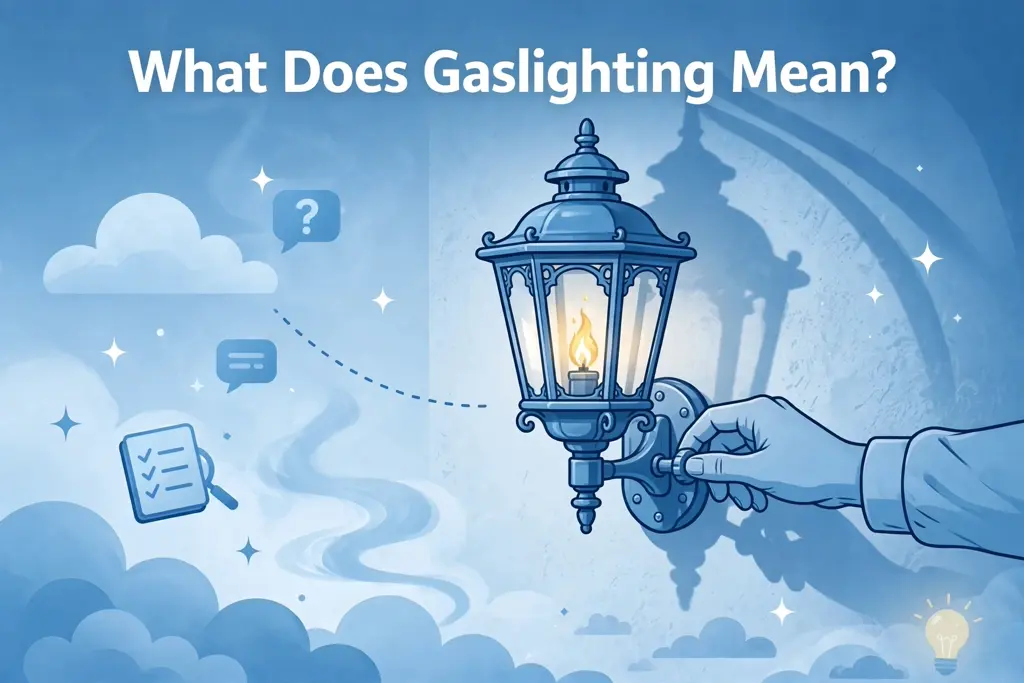
Few words have travelled further, faster, than "gaslighting." It shows up in arguments, headlines, and group chats — usually as a stronger word for lying. But what does gaslighting mean, exactly? Used properly, it names something more specific and more serious than dishonesty, and its unusual name comes from a stage play about a lamp that kept going dim.
The Definition
Merriam-Webster defines gaslighting as psychological manipulation of a person, usually over an extended period of time, that causes the victim to question the validity of their own thoughts, perception of reality, or memories. Three ingredients separate gaslighting from an ordinary lie: it is a pattern, not a single incident; it targets your trust in your own mind, not just one fact; and it leaves you increasingly dependent on the manipulator as the referee of what is real.
Where the Word Comes From
The term traces to Gas Light, a 1938 stage play by British playwright Patrick Hamilton. In the story, a husband secretly dims the household gas lamps while hunting for hidden jewels, then insists to his wife that the light never changed — that she is imagining things. Night after night of confident denial drives her toward doubting her own senses and sanity. The 1944 Hollywood film Gaslight, starring Ingrid Bergman (who won an Academy Award for the role) and Charles Boyer, carried the story worldwide. Psychologists began using "gaslighting" for the real-life pattern in the 1960s and 1970s, and the word exploded in the 2010s — in 2022 Merriam-Webster named it Word of the Year, after lookups rose 1,740%.
7 Signs of Gaslighting
1. Flat Denial of Things That Happened
"I never said that." "That never happened." The denial is delivered with total confidence, even when the event is recent, witnessed, or documented — the confidence itself is the weapon.
2. Countering Your Memory
Your recollections are rewritten in real time: "That's not how it went," "You're remembering it wrong again." Over months, you start outsourcing your memory to the other person.
3. Trivializing Your Feelings
"You're too sensitive." "It was just a joke." Your emotional reactions are treated as evidence that you are the problem, until you begin apologizing for having them at all.
4. Withholding and Stonewalling
The gaslighter pretends not to understand, refuses to listen, or declares the conversation over — "I'm not having this discussion again" — so concerns never get addressed, only buried.
5. Diverting the Blame
Every confrontation gets turned around until the person who raised the issue is the one apologizing. The original behaviour is never examined; your reaction to it becomes the crime.
6. Lying in the Face of Proof
Shown evidence, a practiced gaslighter does not back down — they attack the evidence, the source, or your interpretation of it. The goal is not to win the argument but to exhaust your certainty.
7. Cutting You Off From Other Reality Checks
Friends and family who might validate your perceptions are gradually discredited or discouraged — "they've never liked you," "don't tell them our business" — until the gaslighter is the only mirror you have left.
What Gaslighting Is Not
Not every lie is gaslighting, and neither is every disagreement. Two people can honestly remember an event differently. Someone can be selfish, stubborn, or even deceitful without running a campaign against your sanity. The word loses its power — and does real harm of its own — when it becomes a label for any argument one side dislikes. Gaslighting is the sustained pattern of making another person doubt their own mind.
If It Is Happening to You
Keep a private record of events while they are fresh; written notes anchor memory against later denial. Test your perceptions with people you trust who are outside the situation. And if the pattern is part of a broader pattern of control or abuse, a counsellor or a local support organization can help you think it through — that is a strength move, not an overreaction. Your perceptions are data. Someone who consistently asks you to ignore them is telling you something important.
Quick Summary
Gaslighting is sustained psychological manipulation that makes a person doubt their own thoughts, memories, and perceptions. The word comes from Patrick Hamilton's 1938 play Gas Light and the 1944 film, in which a husband dims the lamps and denies it to destabilize his wife. Its classic signs include flat denial, memory-countering, trivializing feelings, stonewalling, blame-diverting, and isolation. A single lie or argument is not gaslighting — the pattern is.
Frequently Asked Questions
Is gaslighting always done on purpose?
In the classic sense, yes — it is a deliberate strategy, like the husband's in the play. Some people do learn manipulative habits without a master plan, but what defines gaslighting is the pattern and its effect: one person's reality is repeatedly overridden until they stop trusting it.
What is the difference between gaslighting and lying?
A lie hides a fact. Gaslighting attacks the other person's ability to judge facts at all. A liar wants you to believe one false thing; a gaslighter wants you to believe you cannot trust your own memory, senses, or judgement.
Why did gaslighting become so popular as a word?
It filled a gap — there was no common word for this specific pattern of manipulation. As awareness of emotional abuse grew through the 2010s, lookups surged, and Merriam-Webster named it Word of the Year for 2022 after a 1,740% increase in searches.
Can gaslighting happen outside romantic relationships?
Yes. The pattern appears in families, friendships, workplaces, and public life — anywhere one person or institution has enough influence over another to become their referee of reality.
Related Guides
- 7 Essential Misunderstood Words Definitions
- Where Does the Word OK Come From? The Joke That Took Over the World
- How to Verify Information Found Online: 10 Proven Ways to Check Any Claim
External Resources
More in Definitions

What Is Déjà Vu? The Brain Glitch Behind the Eeriest Feeling
What Is Déjà Vu? The Brain Glitch Behind the Eeriest Feeling You walk into a café you have never visited, in a city you have never been to — and you would swear you have sat at that exact table…
What Does Ironic Actually Mean? The 3 Types (and the Song That Got Them Wrong)
What Does Ironic Actually Mean? The 3 Types (and the Song That Got Them Wrong) It is the most confidently misused word in English. People call coincidences ironic, bad luck ironic, and anything…
Where Does the Word OK Come From? The Joke That Took Over the World
Where Does the Word OK Come From? The Joke That Took Over the World It may be the most recognized word on Earth. Astronauts say it, toddlers say it, and people who speak no other English say it. Two…