
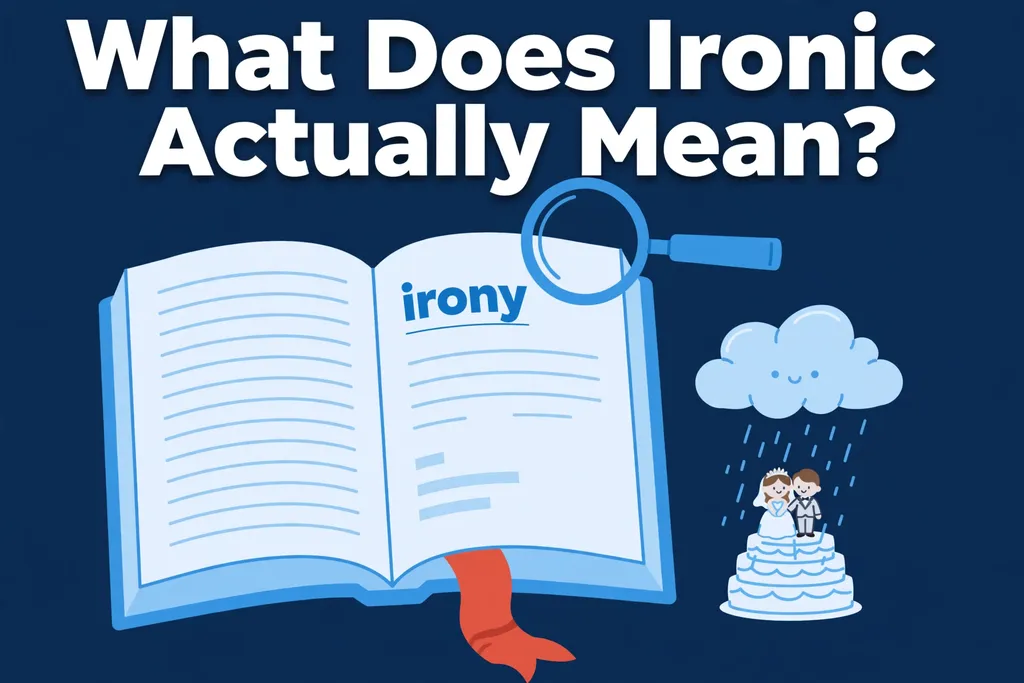
What Does Ironic Actually Mean? The 3 Types (and the Song That Got Them Wrong)
It is the most confidently misused word in English. People call coincidences ironic, bad luck ironic, and anything vaguely surprising ironic — and most of the time, none of it qualifies. So what does ironic actually mean? Underneath all the misuse sits one clean idea, expressed in three distinct forms. Learn the idea and you will spot real irony everywhere — and stop calling everything else by its name.
The Core Idea: The Opposite of What You'd Expect
Merriam-Webster defines irony as the incongruity between the actual result of a sequence of events and the normal or expected result. Strip away the dictionary language and the test is simple: irony needs a gap between expectation and reality — ideally a pointed one, where the outcome mocks the intention. Mere surprise is not enough, and neither is mere misfortune. The universe has to seem to be making a point.
Type 1: Verbal Irony — Saying the Opposite
Verbal irony is when a speaker says one thing and means the opposite: looking out at a hurricane and remarking, "Beautiful weather we're having." It is often confused with sarcasm, but they are not identical — sarcasm is verbal irony with an edge, meant to mock or wound. Plenty of verbal irony is gentle: a friend who drops their phone in a puddle and deadpans "Perfect." is being ironic, not sarcastic. Julius Caesar's Mark Antony, praising "honourable" Brutus over and over while meaning the reverse, is the classic literature example.
Type 2: Situational Irony — Reality Does the Opposite
Situational irony is when events themselves deliver the opposite of what anyone would reasonably expect. The canonical example: a fire station burning down. A marriage counsellor filing for divorce, a tow truck getting towed, the inventor of the Segway dying in a Segway accident (which really happened, in 2010) — the facts arrange themselves into a punchline nobody wrote. The key ingredient is reversal: the very thing meant to prevent an outcome, or the person least likely to suffer it, is what delivers it.
Type 3: Dramatic Irony — The Audience Knows
Dramatic irony lives in stories: the audience knows something the characters do not, and every scene is charged by that gap. In Romeo and Juliet, we know Juliet is only sleeping; Romeo does not, and the tragedy unfolds from his ignorance. Horror movies run on it — we saw the killer enter the house, the heroine humming in the kitchen did not. It is the engine of suspense, and of half the "don't go in there!" moments in film history.
The Alanis Problem
Which brings us to the song. Alanis Morissette's 1995 hit "Ironic" is the most famous catalogue of non-irony ever recorded. Rain on your wedding day is bad luck. A traffic jam when you're already late is an annoyance. Ten thousand spoons when all you need is a knife is poor drawer planning. Comedian Ed Byrne built an entire routine on exactly this — pointing out that a traffic jam would only be ironic if the road had been built specifically to eliminate traffic jams. To be fair, one lyric nearly makes it: the man who wins the lottery and dies the next day works, because the win's whole point was a better future he never gets. And there is a beloved defence of the song: a song called "Ironic" containing no irony is itself... ironic. Morissette, for her part, has always said they were chasing life's little cruelties, not writing a linguistics thesis.
A Field Test for Your Next "Ironic"
Before you use the word, ask two questions. Did the opposite of the reasonable expectation happen? And is there a twist that makes the reversal feel pointed — a fire station, of all places, burning down? If you only have coincidence or bad luck, the honest words are "unlucky," "weird timing," or "you couldn't make it up." Save "ironic" for when the universe has genuinely written a punchline.
Quick Summary
Ironic describes a gap between expectation and reality. Verbal irony: saying the opposite of what you mean. Situational irony: the opposite of the expected outcome happening — a fire station burning down. Dramatic irony: the audience knowing what the characters don't. Coincidence and bad luck, however poetic, are not irony — which is why most of the Alanis Morissette song is, famously, a list of bummers instead.
Frequently Asked Questions
Is rain on your wedding day ironic?
No — it is unfortunate, not ironic. It would approach irony if, say, you had moved your wedding across the country specifically to escape the rainy season and it rained only on your venue. Irony needs the outcome to reverse an expectation or intention, not just spoil a day.
Is sarcasm the same as irony?
Sarcasm is a sharp-edged form of verbal irony — saying the opposite of what you mean, with mocking intent. Verbal irony can be playful or neutral; sarcasm always has a target.
What is an example of dramatic irony?
In Romeo and Juliet, the audience knows Juliet has taken a sleeping potion, but Romeo believes she is dead. His actions, driven by that false belief, produce the tragedy — the audience watches it unfold with knowledge the characters lack.
Why do so many people misuse "ironic"?
Because the loose usage — "ironic" as a synonym for "coincidentally funny" — has been widespread for decades, reinforced by popular culture (including a certain 1995 hit). Dictionaries note the broader use, but the three strict types are what the word properly names.
Related Guides
- 7 Essential Misunderstood Words Definitions
- What Does Gaslighting Mean? Origin, 7 Signs, and How to Respond
- Where Does the Word OK Come From? The Joke That Took Over the World
External Resources
More in Definitions
What Is Déjà Vu? The Brain Glitch Behind the Eeriest Feeling
What Is Déjà Vu? The Brain Glitch Behind the Eeriest Feeling You walk into a café you have never visited, in a city you have never been to — and you would swear you have sat at that exact table…
What Does Gaslighting Mean? Origin, 7 Signs, and How to Respond
What Does Gaslighting Mean? Origin, 7 Signs, and How to Respond Few words have travelled further, faster, than "gaslighting." It shows up in arguments, headlines, and group chats — usually as a…
Where Does the Word OK Come From? The Joke That Took Over the World
Where Does the Word OK Come From? The Joke That Took Over the World It may be the most recognized word on Earth. Astronauts say it, toddlers say it, and people who speak no other English say it. Two…