
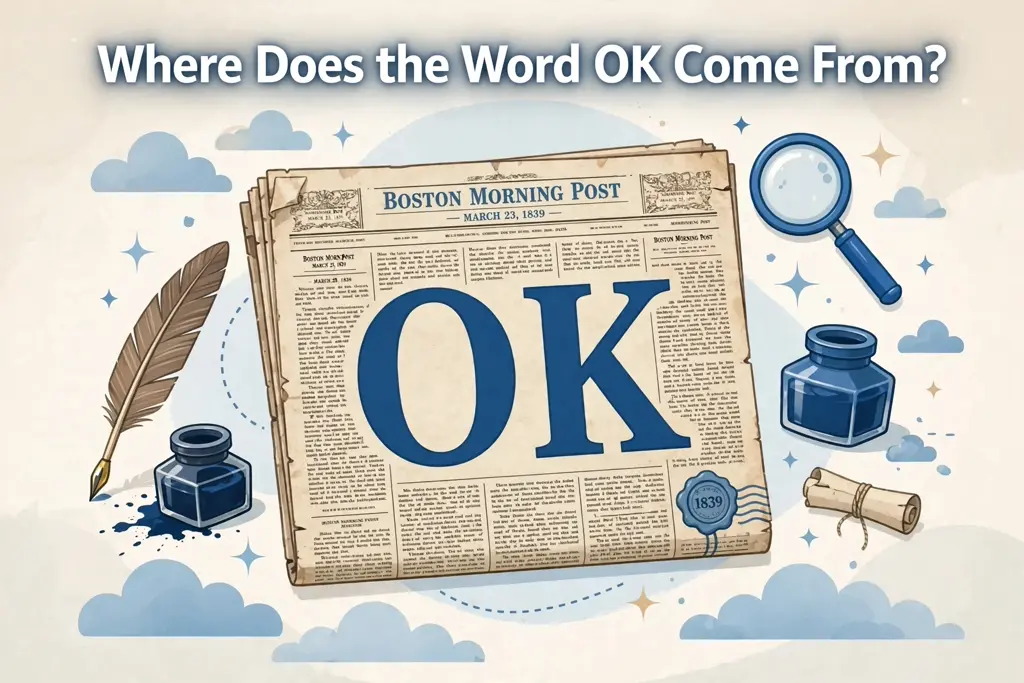
Where Does the Word OK Come From? The Joke That Took Over the World
It may be the most recognized word on Earth. Astronauts say it, toddlers say it, and people who speak no other English say it. Two letters, understood everywhere — and almost nobody guesses the origin correctly. So where does the word OK come from? Not from a war, a president's initials, or an ancient language. It comes from a joke in a Boston newspaper that readers were meant to forget by the following week.
Boston, 1839: A Joke in the Morning Paper
The first confirmed appearance of OK in print is on page 2 of the Boston Morning Post for March 23, 1839. The editor, Charles Gordon Greene, slipped it into a running gag about a group called the Anti-Bell-Ringing Society, signing off a paragraph with "o. k. — all correct —". The joke only works as a joke: "all" does not start with O, and "correct" does not start with K. Greene was writing "all correct" the way a comedian would — deliberately, hilariously wrong.
The Fad Behind the Joke
Greene's readers got it instantly, because Boston in 1838–39 was in the grip of a newspaper craze for comic abbreviations built on deliberate misspellings. Papers traded initials like O.W. for "oll write" (all right) and K.G. for "know go" (no go). It was the era's favourite humour format — the 1839 equivalent of a meme template. OK was simply the entry that landed best: "oll korrect," the deliberately bungled spelling of "all correct."
The Election That Saved OK
Fad words are supposed to die with the fad, and OK nearly did. What rescued it was the presidential election of 1840. The incumbent, Martin Van Buren, came from Kinderhook, New York — so his supporters rebranded OK as "Old Kinderhook" and founded "O.K. Clubs" across the country. The double meaning put the two letters on banners, in newspapers, and in everyday speech nationwide. By the time the election ended, OK no longer needed the original joke to survive.
A Century of Wrong Answers
Because OK was everywhere, everyone assumed it must have an impressive origin, and for over a century the theories piled up. It was said to come from the Choctaw word okeh, "it is so" — a theory President Woodrow Wilson liked so much he spelled the word "okeh" himself. Others proposed the Greek ola kala ("all good"), the Haitian port of Aux Cayes and its rum, a biscuit maker named Orrin Kendall who supplied Union soldiers, or battlefield shorthand for "zero killed." All of them are wrong, and we know it thanks to one stubborn detective.
The Linguist Who Solved It
In the 1960s, Columbia University professor Allen Walker Read — the leading scholar of historical American English — treated OK like a cold case. He read through Boston's newspapers of the late 1830s essentially page by page, tracing every early use back through the abbreviation craze until all of them converged on Greene's March 23, 1839 item. His research, published in 1963–64, dismantled the rival theories one by one. No earlier written example of OK has ever been found. The joke origin is not just the best story; it is the documented one.
Why OK Conquered the World
OK had survival advantages no rival word could match. It is two letters — cheap to print, quick to say, and ideal for the telegraph age that was just arriving, because in Morse code and in a noisy room, "OK" is almost impossible to misunderstand. And it is shapeshifting: it can mean yes, I understand, good enough, stop, or mediocre, depending entirely on tone. A word that flexible, that short, and that early to global communication networks was never going to stay a Boston joke.
Quick Summary
OK was born on March 23, 1839, in the Boston Morning Post, where editor Charles Gordon Greene used "o. k." as a joke abbreviation for the deliberately misspelled "oll korrect" — all correct. It rode a Boston fad for comic misspellings, survived thanks to the 1840 election's "Old Kinderhook" clubs, and spread worldwide on the telegraph. Linguist Allen Walker Read proved the origin in the 1960s, beating a century of theories from Choctaw words to Greek phrases.
Frequently Asked Questions
What does OK stand for?
"Oll korrect" — a deliberately misspelled joke version of "all correct," printed in the Boston Morning Post on March 23, 1839. Later generations invented grander explanations, but the humble joke is the documented origin.
How old is the word OK?
OK dates to 1839, making it more than 185 years old. It predates the telephone, the light bulb, and the first telegraph message — and then rode all of those technologies around the world.
Did OK come from the Choctaw word "okeh"?
That was the most popular rival theory — even President Woodrow Wilson favoured it. But Allen Walker Read's research showed the Boston 1839 print origin, and no earlier written example from any source has ever surfaced.
Why is OK understood in so many languages?
Because it spread early through telegraphy, trade, war, and American media, and because it is extraordinarily useful: two sounds that can signal agreement, understanding, or approval. Many languages simply borrowed it as-is.
Related Guides
- 7 Essential Misunderstood Words Definitions
- What Does Gaslighting Mean? Origin, 7 Signs, and How to Respond
- 7 Bizarre Historical Facts You Probably Never Learned
External Resources
More in Definitions
What Is Déjà Vu? The Brain Glitch Behind the Eeriest Feeling
What Is Déjà Vu? The Brain Glitch Behind the Eeriest Feeling You walk into a café you have never visited, in a city you have never been to — and you would swear you have sat at that exact table…
What Does Ironic Actually Mean? The 3 Types (and the Song That Got Them Wrong)
What Does Ironic Actually Mean? The 3 Types (and the Song That Got Them Wrong) It is the most confidently misused word in English. People call coincidences ironic, bad luck ironic, and anything…
What Does Gaslighting Mean? Origin, 7 Signs, and How to Respond
What Does Gaslighting Mean? Origin, 7 Signs, and How to Respond Few words have travelled further, faster, than "gaslighting." It shows up in arguments, headlines, and group chats — usually as a…