
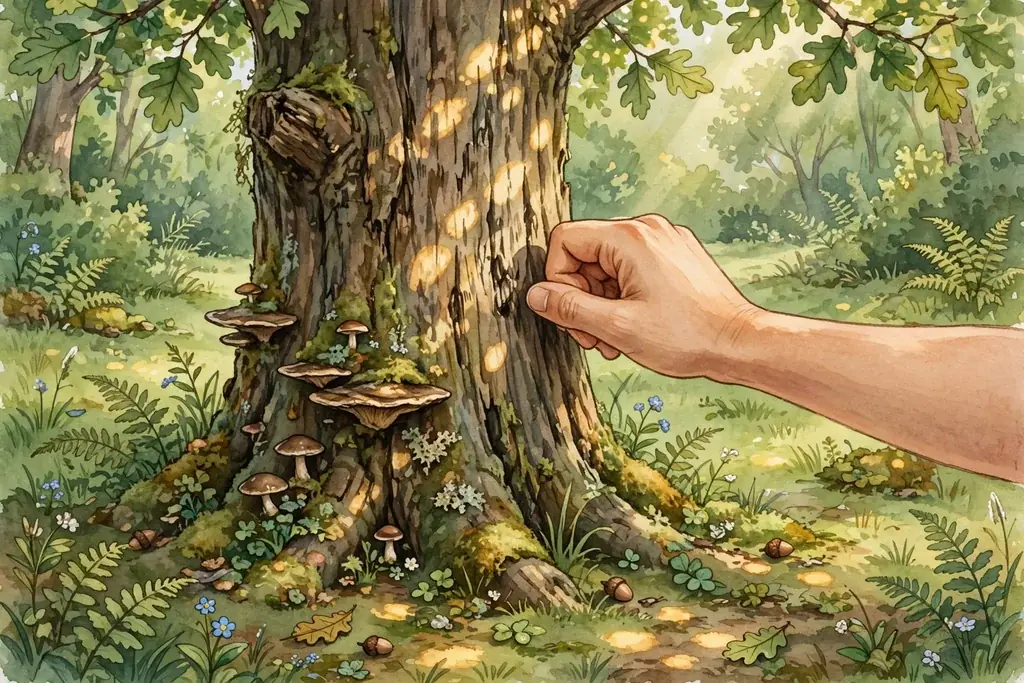
Why Do We Knock on Wood? The Surprisingly Modern Origin of an Old Superstition
You have just said something tempting fate — "I have never had a car accident," or "the baby slept through the night for once" — and before the sentence is finished, your knuckles are already rapping on the nearest table. So why do we knock on wood? Ask around and you will hear a confident story about ancient tree spirits and Celtic druids. It is a good story. The trouble is that the evidence points somewhere much more recent, and much more ordinary: a children's playground game from the 1800s. The real history of knocking on wood is a lesson in how a plausible ancient origin can be invented long after the fact.
The Popular Story: Tree Spirits and Ancient Magic
The version most people know goes like this. Ancient peoples believed that trees housed protective spirits or gods, and that touching or knocking on wood called on those spirits for protection or thanked them for good fortune. Some versions credit the Celts, who supposedly believed spirits lived in trees; others credit early Christians, who supposedly touched wooden crosses; still others point to a supposed pagan habit of knocking to wake the spirits or to keep evil from overhearing a boast.
It is a satisfying story because it feels ancient, and because it explains the gesture with a single vivid image. It also has a serious problem: nobody has found it in the historical record. There is no ancient text, no medieval source, no early folklore collection that describes people knocking on wood to avert bad luck or summon tree spirits. The story appears, fully formed, only in modern popular books about superstitions — long after the custom itself was already common. That is a red flag for any origin story, and folklorists have treated it as one.
What the Evidence Actually Shows: A Children's Game
The earliest known reference to knocking on wood comes from 1805, and it is not a ritual at all. It is a children's chasing game. In a game called "tiggy touchwood," a player being chased was safe from being caught as long as they were touching wood. The wood was a sanctuary — a base, like home in tag. Children across Britain played versions of this game through the 1800s, and the phrase "touch wood" grew up with it.
Folklorists Jacqueline Simpson and Steve Roud, who have studied the custom in depth, argue that this playground game is almost certainly the real origin of the superstition. The logic of the leap is easy to see: wood as a place of safety in a game becomes wood as a source of safety in life, and a child's habit of touching wood to avoid being caught becomes an adult's habit of touching wood to avoid being caught out by fate. The gesture kept its meaning — protection — while its context changed completely.
This also explains a small linguistic clue. In Britain, the saying is usually "touch wood," not "knock on wood" — exactly the wording of the game, where touching was enough and knocking was never required. The American "knock on wood" variant came later, as the custom crossed the Atlantic and the gesture hardened into two or three sharp raps. If the custom had truly descended from an ancient ritual, you would expect the language to reflect the ritual. Instead it reflects a game.
How the Superstition Spread
Once the habit existed, it spread the way superstitions do: by imitation, by social pressure, and by the human brain's talent for spotting patterns that are not there. Say something boastful, knock on wood, and nothing bad happens — the ritual gets the credit. Forget to knock, and something goes wrong — the omission gets the blame. Psychologists call this pattern illusory correlation, and it is powerful enough to keep a habit alive for generations without any real evidence behind it.
The 20th century gave the custom a boost through popular culture. By the early 1900s, "knock on wood" was appearing in newspapers, songs, and plays as a recognizable gesture, and it has never left. It survived because it costs nothing, takes a second, and feels like doing something in situations where you can actually do nothing. Tempting fate is a feeling of exposure; knocking on wood is a feeling of control, however symbolic.
The Same Instinct, Around the World
Other cultures have their own versions of the same impulse, and the variations are revealing. In Turkey, people knock twice on wood and then tug their own earlobe — a gesture said to ward off the evil eye after a boast. In Italy, the equivalent phrase is "touch iron" rather than "touch wood," reflecting a different folk tradition in which iron, not wood, repels evil. In parts of the Middle East and Latin America, similar knocking and touching gestures accompany the same moment: the boast, the good news, the sentence you wish you could unsay.
The variety is the point. If knocking on wood came from one ancient source, you would expect one consistent form. Instead, different cultures independently landed on the same basic idea — touch something solid, perform a small ritual, and feel safer — which suggests the instinct is human and universal, while the specific gesture is local and recent. The tree-spirit story is one culture's later explanation for a habit it already had.
So Should You Keep Knocking?
There is no harm in it, and there is a small psychological benefit that researchers take seriously: rituals, even ones we know are irrational, genuinely reduce anxiety. Knocking on wood after a boast is a way of acknowledging the boast, marking it as risky, and moving on. It is a social signal too — it tells the people around you that you know you may have tempted fate, which is itself a modest, likable form of humility.
The honest history does not make the habit less interesting. If anything, it makes it more so: a children's game from 1805, in which wood meant safety from a tagger, quietly grew into one of the most widespread superstitions in the English-speaking world. The ancient druids had nothing to do with it. A playground did.
Quick Summary
Knocking on wood is the habit of rapping on wood after a boast or a piece of good news, to avoid tempting fate. The popular story credits ancient tree spirits or Celtic druids, but no early source supports it. The earliest known reference is from 1805, in the children's chasing game "tiggy touchwood," where touching wood made a player safe. Folklorists Simpson and Roud argue the game is almost certainly the origin, with Britain's "touch wood" preserving the game's wording and America's "knock on wood" developing later.
Frequently Asked Questions
Where does knocking on wood come from?
The earliest documented source is an 1805 children's chasing game called "tiggy touchwood," in which a player touching wood was safe from being caught. Folklorists argue this game is almost certainly the origin of the superstition, rather than the popular ancient tree-spirit story.
Is the tree-spirit origin story true?
There is no historical evidence for it. No ancient or medieval source describes knocking on wood to summon tree spirits or avert bad luck. The story appears only in modern popular books about superstitions, long after the custom was already widespread.
Why do British people say touch wood instead of knock on wood?
Because the phrase preserves the wording of the original game, where touching wood was enough to be safe. The American "knock on wood" variant, with its sharp raps, developed later as the custom crossed the Atlantic.
Do other countries have a version of knocking on wood?
Yes. In Turkey, people knock twice on wood and tug an earlobe to ward off the evil eye. In Italy, the equivalent is "touch iron," reflecting a folk tradition in which iron repels evil. Many cultures share the same basic impulse: a small ritual after a boast, to feel safer.
Related Guides
- Why Do We Say Bless You When Someone Sneezes? 4 Surprising Origins
- Why Are School Buses Yellow? The 1939 Decision That Stuck
- Why Do Golf Balls Have Dimples? The Accident That Doubled the Drive
External Resources
More in Other Curiosities
Why Do Golf Balls Have Dimples? The Accident That Doubled the Drive
Why Do Golf Balls Have Dimples? The Accident That Doubled the Drive It looks like a manufacturing defect, and it is the opposite: the hundreds of tiny craters on a golf ball are the reason a drive…

Why Are School Buses Yellow? The 1939 Decision That Stuck
Why Are School Buses Yellow? The 1939 Decision That Stuck Every school bus in North America wears the same shade — not just yellow, but one specific yellow-orange with its own official name. Nobody's…

Why Do We Say Bless You When Someone Sneezes? 4 Surprising Origins
Why Do We Say Bless You When Someone Sneezes? 4 Surprising Origins Sneeze in an elevator and a stranger will bless you automatically, without thinking. Cough in the same elevator and you will get…