
How to Remove Sticker Residue from Almost Anything: 6 Methods That Work
The sticker came off. The glue did not. Now you have a jar, a laptop, a book, or a window with a tacky patch that collects dust and refuses every casual wipe. So how to remove sticker residue without ruining the thing underneath? The answer depends entirely on the surface, because the method that rescues glass can destroy plastic, and the solvent that cleans metal can strip paint. Here are six methods that work, matched to the surfaces they suit — and the mistakes to avoid on each one.
First, the Golden Rule: Test in a Hidden Spot
Before any method below touches a visible area, test it somewhere hidden: the bottom of the jar, the inside of a lid, the back of a frame. Apply a small amount, wait a minute, wipe, and check for discolouration, clouding, softening, or finish damage. This one habit prevents nearly every sticker-removal disaster. Adhesives vary — a price label, a bumper sticker, and a child's sticker use different glues — and surfaces vary even more. The test spot costs you sixty seconds and can save the item.
Also start with the gentlest method that could work, and only escalate if the residue survives. Peel off as much of the sticker and loose glue as you can with a fingernail or a plastic scraper first. An old bank card or a plastic putty knife works well; a metal blade does not belong on most surfaces. Removing the bulk mechanically means less chemical work later, whatever method you choose.
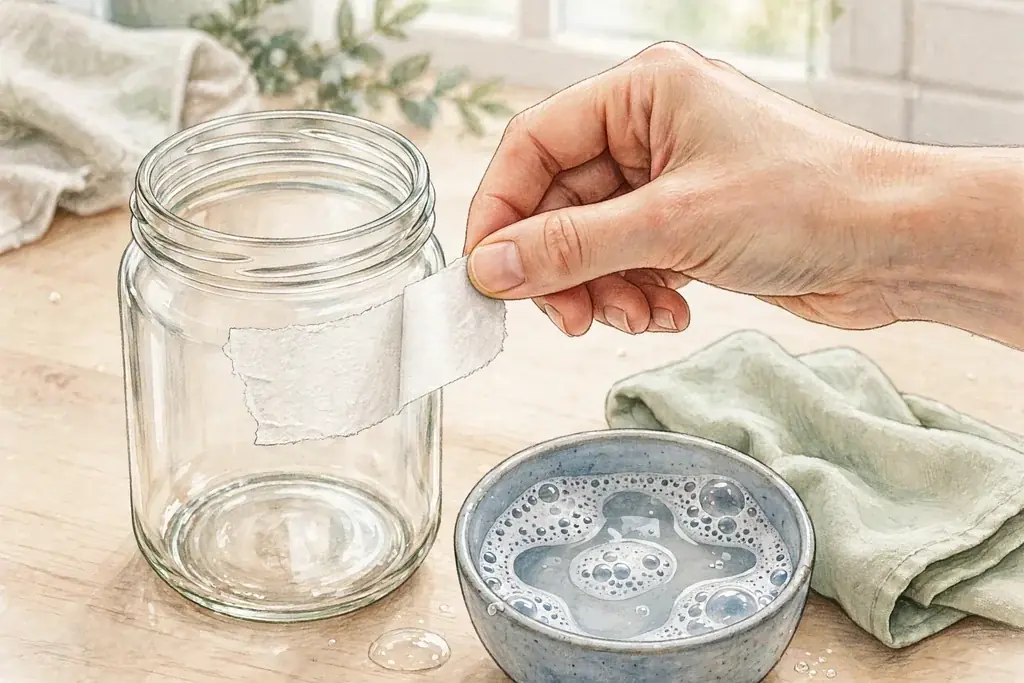
Method 1: Warm Soapy Water Soak (Glass, Ceramics, Metal)
For jars, bottles, dishes, and anything that can be submerged, warm soapy water is the best first move. Fill a sink with hot water and dish soap, submerge the item, and let it soak until the adhesive softens — often ten to twenty minutes for a fresh label, longer for an old one. Then rub with a cloth or the rough side of a sponge. For items too big to soak, like a window or a mirror, soak a towel in the same solution and lay it over the residue, re-wetting it every fifteen minutes or so.
This method works because most water-based label adhesives soften in hot water, and the soap helps lift the residue away rather than smearing it around. It is also the safest method in this guide: it will not damage glass, ceramic, or uncoated metal, and it leaves nothing behind but clean surface. Its limits are obvious — you cannot soak a book, a laptop, or a wooden table — but for washable items it should always be the first attempt.
Method 2: Cooking Oil or Peanut Butter (Glass and Metal)
Oil dissolves adhesive in a way water cannot. Rub a thin layer of cooking oil — vegetable, canola, or coconut — over the residue, let it sit for ten to fifteen minutes, then wipe away with a soft cloth. Peanut butter works on the same principle, since it is mostly oil, and its thicker texture helps it cling to vertical surfaces like the side of a jar. The oil breaks down the sticky bond, and the residue lifts off with it.
This method shines on glass and metal, where an oily film is easy to wash off afterwards with warm soapy water. Be more cautious on porous surfaces: oil can stain unfinished wood and soak into paper, so keep it away from those. And always wash the item thoroughly after, because an invisible oil film will attract dust and feel tacky in its own right. Done properly, though, oil is one of the most reliable residue removers in the kitchen, and it costs nothing you do not already own.
Method 3: Rubbing Alcohol (Hard, Non-Porous Surfaces)
Rubbing alcohol — isopropyl alcohol, the kind in a medicine cabinet — is the fastest option for hard, non-porous surfaces like glass, metal, and many hard plastics. Dampen a cloth with it, rub the residue gently, and watch it dissolve. Alcohol evaporates cleanly, leaving no greasy film, which makes it ideal for items like picture frames, glass bottles, and electronics housings where you do not want to rinse afterwards.
Its limits matter. Alcohol can damage some finishes, dull certain plastics, and strip the coating from soft-touch rubberized surfaces, so the hidden-spot test is essential here. Never use it on coated screens, and keep it away from open flames — it is flammable. Also avoid nail polish remover unless you know exactly what you are doing: acetone, its active ingredient, dissolves many plastics outright and will cloud or melt a plastic surface in seconds. Rubbing alcohol is the safe middle ground; acetone is a different, far more aggressive chemical.
Method 4: Hair Dryer Heat (Stickers Still Attached, Painted Surfaces)
Heat softens adhesive before you even start scraping, which makes it the best method when the sticker itself is still on — or when the residue sits on a painted surface that chemicals might damage. Aim a hair dryer at the sticker or residue for about thirty seconds on a medium setting, then peel or scrape gently with a plastic card. If resistance returns, heat again for another thirty seconds and continue. Patience beats force: a sticker removed slowly under heat leaves far less residue than one ripped off cold.
Heat is also the safest choice for painted wood and car paint, where solvents risk stripping the finish. Keep the dryer moving rather than holding it on one spot, and use a low or medium setting — high heat can bubble paint, warp thin plastic, or scorch wood. For bumper stickers, the same technique applies, followed by a gentle wipe with warm soapy water to catch the last film of glue.
Method 5: Baking Soda and Oil Paste (Stubborn Spots)
When a single method leaves a thin, stubborn film behind, combine two of them. Mix baking soda with a little cooking oil into a thick paste, rub it over the residue with a soft cloth, let it sit for a few minutes, then wipe clean and wash with warm soapy water. The baking soda adds a very mild abrasive action that helps lift the last of the glue, while the oil dissolves what the abrasion loosens.
This paste is excellent on glass jars, metal tins, and ceramic tiles — the surfaces where a little scrubbing is safe. Use it cautiously on anything with a delicate finish: even a mild abrasive can dull a polished surface or scratch soft plastic if you scrub hard. As always, the hidden-spot test comes first, and a light touch beats enthusiasm. For truly stubborn residue on glass, a second application usually finishes the job the first one started.
Method 6: Rubber Eraser (Paper-Safe Light Residue)
For paper, cardboard, and book covers — surfaces where liquids are the enemy — a plain rubber eraser is the gentlest tool available. Rub it lightly over the residue and it will roll the glue into small crumbs you can brush away. It works best on light residue left after a sticker has been peeled carefully; it will not handle a thick layer of industrial adhesive, but for a price tag on a book jacket or a label on a greeting card, it is often enough.
The key is lightness. Pressing hard or scrubbing aggressively will pill the paper surface or tear it, which is worse than the residue was. Short, gentle strokes, checked frequently, are the technique. For books you care about, an eraser used patiently is far safer than any liquid, and it leaves nothing behind — no moisture, no oil, no chemical smell. If the residue resists the eraser entirely, accept the limit: some paper residue is better left alone than risked with solvents.
What Never to Use Where
A short list of hard rules will prevent most disasters. Never use abrasives — steel wool, scouring pads, gritty cleaners — on coated screens, painted wood, or soft plastic; the scratches are permanent and worse than the glue. Never use acetone or nail polish remover on plastic, since it can dissolve the surface. Never soak unfinished wood, since water and oil both stain it permanently. And never use a metal scraper on glass you care about, on paint, or on plastic — a plastic card held almost flat does the same job without gouging. When in doubt, stop, test, and escalate slowly.
Quick Summary
To remove sticker residue, start gentle and match the method to the surface: soak washable glass, ceramic, and metal in warm soapy water; use cooking oil or peanut butter on glass and metal; use rubbing alcohol on hard, non-porous surfaces; use hair dryer heat for stickers still attached and for painted surfaces; try a baking soda and oil paste for stubborn film on hard surfaces; and use a rubber eraser for light residue on paper. Always test in a hidden spot first, and never use abrasives on coated screens or painted wood, or acetone on plastic.
Frequently Asked Questions
What is the easiest way to remove sticker residue from a glass jar?
Soak the jar in hot, soapy water for ten to twenty minutes, then rub with a cloth or sponge. For stubborn film, follow up with cooking oil or a baking soda and oil paste, then wash again with warm soapy water to remove any oily film.
Can I use rubbing alcohol on plastic?
On most hard plastics, yes, applied to a cloth rather than sprayed directly — but test in a hidden spot first, because alcohol can dull some plastics and damage soft-touch coatings. Never use acetone or nail polish remover on plastic, since it can dissolve the surface.
How do I remove sticker residue from wood without damaging it?
Use a hair dryer on a medium setting to soften the adhesive, then lift it gently with a plastic card. Avoid soaking unfinished wood, since water and oil can stain the grain permanently, and avoid harsh solvents on painted or finished wood.
How do I remove sticker residue from paper or a book?
Use a plain rubber eraser with light, short strokes — it rolls light residue into crumbs without moisture or chemicals. Press gently and check often, since hard scrubbing can pill or tear the paper. Some residue on paper is better left than risked with solvents.
Related Guides
- How to Remove Permanent Marker from Almost Anything: 6 Methods by Surface
- Why Does My Smoke Detector Keep Chirping? 5 Causes and the Fixes
- How to Fix a Leaky Kitchen Faucet: Step-by-Step DIY Guide
External Resources
More in How-To & Fixes
How to Remove Permanent Marker from Almost Anything: 6 Methods by Surface
How to Remove Permanent Marker from Almost Anything: 6 Methods by Surface Here is the secret the name hides: permanent marker is only permanent against water. Its ink is pigment locked in a resin…
Why Does My Smoke Detector Keep Chirping? 5 Causes and the Fixes
Why Does My Smoke Detector Keep Chirping? 5 Causes and the Fixes It never starts at noon. It starts at 3 a.m. — one chirp, every minute or so, from a detector you cannot quite locate in the dark. Why…
How to Get Rid of Fruit Flies: 6 Methods That Actually Work
How to Get Rid of Fruit Flies: 6 Methods That Actually Work One forgotten banana on Monday can mean a cloud of tiny flies by Friday. Fruit flies seem to materialize from nowhere because their life…