
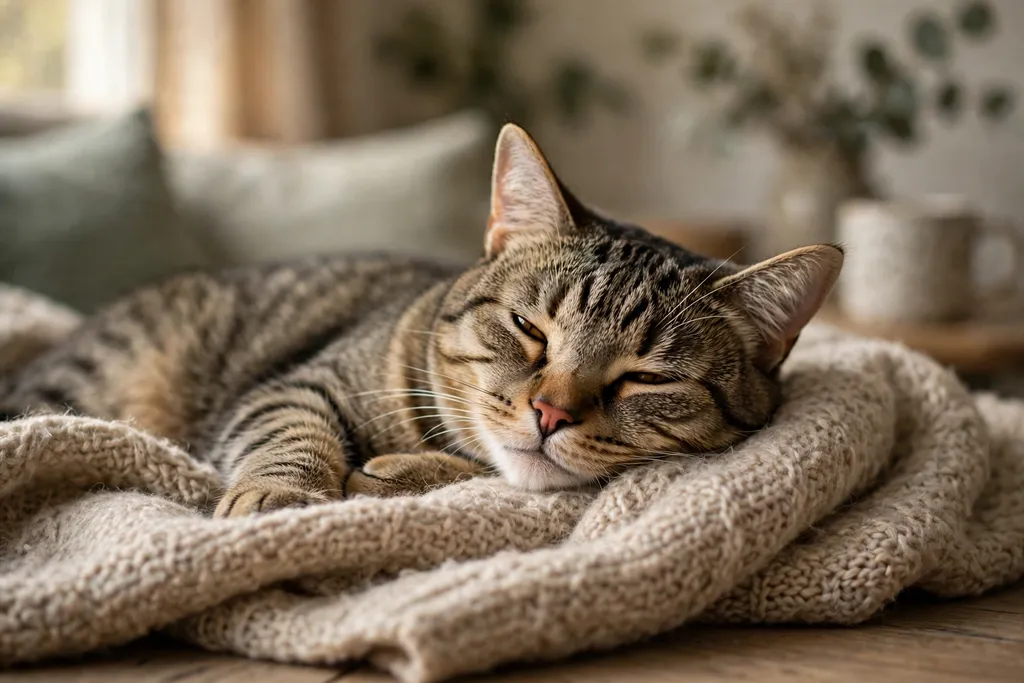
Why Do Cats Purr? The Science Behind the Sound
If you have ever had a cat settle on your lap, tuck its paws beneath itself, and start up that low, steady rumble, you know how soothing the sound can be. It feels like the clearest possible signal of a happy animal. Yet the more scientists have studied purring, the more complicated the picture has become. So why do cats purr? The honest answer is that they purr for several different reasons, and contentment is only one of them. A purr can mean pleasure, but it can also mean anxiety, pain, hunger, or a request for attention. The sound is made by rhythmic signals from the brain to the muscles of the voice box, it happens on both the in-breath and the out-breath, and its frequency falls roughly in the range of 25 to 150 hertz.
How a Purr Is Actually Made
The widely accepted explanation today is that the brain sends rhythmic signals to the laryngeal muscles, the muscles of the voice box, and to the diaphragm, the large muscle that drives breathing. These muscles twitch in a regular pattern, roughly 20 to 30 times per second, alternately narrowing and opening the glottis, the space between the vocal folds.
Each twitch briefly closes the glottis and builds up a little pressure; each release lets air through with a burst of sound. Because the cat keeps breathing steadily throughout, the vibration continues on both inhalation and exhalation, which is why a purr sounds continuous rather than broken into separate breaths. The fundamental frequency of most domestic cat purrs sits around 25 to 30 hertz, while the full range of purring sounds, including harmonics, extends roughly from 25 to 150 hertz.
Why the Frequency Range Has Attracted So Much Attention
Here is where the science gets interesting, and where it is important to separate what is known from what is merely plausible. Researchers have noted that the frequency band of a cat purr overlaps with frequencies used in vibration research on bone and soft tissue. This overlap led to a hypothesis, sometimes called the healing purr hypothesis, that purring may help cats maintain bone density and support tissue repair during long periods of rest.
The reasoning is appealing. Cats sleep for much of the day and then burst into sudden activity, yet they tend to recover from bone injuries relatively well. A low-energy vibration that gently stimulates muscles and bones while the animal rests would be a neat evolutionary trick. But it is essential to be clear: this is a hypothesis supported by overlapping frequency bands and by findings from vibration studies in other contexts, not a proven medical fact about cats, and certainly not a basis for claims about human health.
Contentment: The Purr We Know Best
None of that uncertainty changes the most familiar picture. Cats very often purr when they are relaxed and comfortable: stretched out in a patch of sunshine, kneading a favourite blanket, being stroked by a person they trust, or eating a meal they enjoy.
This is also how purring starts in life. A mother cat purrs while nursing, and her kittens begin purring within days of birth. Because newborn kittens are born blind and deaf, they cannot see or hear their mother in the usual way, but they can feel vibration. The purr acts as a kind of beacon, guiding them toward her and signalling that all is well.
Purring When Stressed, Hurt, or Frightened
The same sound, however, shows up in very different circumstances. Cats frequently purr at the veterinary clinic, in an unfamiliar carrier, after an injury, during labour, and when frightened by a loud noise or a strange animal. A cat that is clearly tense, with flattened ears, dilated pupils, and a tucked body, may still be purring loudly. This is the observation that most surprises new cat owners, and it is the strongest evidence that purring is not simply a happiness signal.
Researchers interpret this stress purring in a few complementary ways. One is self-soothing: the cat may purr to calm itself, much as a person might hum when anxious. Another is communication: a purr may signal to other cats, or to a perceived threat, that the purring cat is not looking for a fight. A behaviour can serve more than one purpose, and purring very likely does. Do not read a purr on its own: read it with the cat's posture, ears, eyes, and context.
The Solicitation Purr: A Special Request
There is one more variety of purr that cat owners know well, even if they have never heard its scientific name. In a study published in Current Biology in 2009, researchers at the University of Sussex led by Karen McComb identified what they called the solicitation purr: a purr that cats use specifically when they want something, usually food, from their owners.
The solicitation purr is a normal purr with an extra ingredient embedded in it: a higher-frequency, cry-like component that makes it sound more urgent and harder to ignore. The researchers suggested that the cry-like element resembles the sound of a human infant crying closely enough to tap into our caregiving instincts, which may be why it works so well.
What Your Cat's Purr Is Telling You
Putting it together, a purr is best understood as a versatile tool rather than a single message. In kittens it guides and reassures. In relaxed adults it accompanies pleasure and social bonding. In stressed or injured cats it may soothe, appease, or request help. In hungry cats it can be a deliberate and effective nudge aimed squarely at a human. Learning to hear the differences — the deep, even rumble of a relaxed cat versus the thinner, more urgent solicitation purr versus the tense purr of a frightened one — takes time, but it is time well spent.
Quick Summary
Cats purr when the brain sends rhythmic signals to the laryngeal muscles and diaphragm, opening and closing the glottis about 20 to 30 times per second, producing a vibration in the 25 to 150 hertz range. They purr when content, but also when stressed, injured, or frightened, and they use a special solicitation purr with a cry-like component to ask humans for food. The idea that purring frequencies may support bone and tissue health is a hypothesis based on overlapping frequency bands, not a proven medical fact.
Frequently Asked Questions
Do cats only purr when they are happy?
No. Cats often purr when content, but they also purr when stressed, frightened, in pain, or recovering from injury. A purr on its own is not a reliable sign of happiness; check the cat's posture and the situation too.
How do cats physically produce a purr?
The brain sends rhythmic signals to the laryngeal muscles and the diaphragm, which twitch about 20 to 30 times per second and alternately narrow and open the glottis. Air passing through during both inhalation and exhalation creates the continuous vibrating sound.
Can a cat's purr heal bones?
That is a hypothesis, not a proven fact. Purring frequencies overlap with frequency bands studied in vibration research on bone and tissue, which makes the idea plausible, but it has not been proven in cats.
What is a solicitation purr?
A solicitation purr is an ordinary purr with an extra higher-frequency, cry-like component embedded in it, identified by researchers at the University of Sussex. Cats use it when they want something from their owners, usually food.
Related Guides
- Why Do We See Lightning Before We Hear Thunder? The Flash-to-Bang Rule, Explained
- Why Do Onions Make You Cry? The Chemistry of the Tear Gas in Your Kitchen
- Why Is the Ocean Salty? 6 Fascinating Facts About the Sea
External Resources
More in Facts & Explanations

Why Do We Get Goosebumps? The Ancient Reflex Behind the Shiver
Why Do We Get Goosebumps? The Ancient Reflex Behind the Shiver Step out into a cold wind, hear a song that hits you just right, or watch a moment of unexpected kindness in a film, and your skin…

Why Do Onions Make You Cry? The Chemistry of the Tear Gas in Your Kitchen
Why Do Onions Make You Cry? The Chemistry of the Tear Gas in Your Kitchen Every cook knows the moment: the knife goes through the onion, and within seconds your eyes sting, water, and blur your…

Why Do We See Lightning Before We Hear Thunder? The Flash-to-Bang Rule, Explained
Why Do We See Lightning Before We Hear Thunder? The Flash-to-Bang Rule, Explained Watch any summer thunderstorm and the pattern is always the same: a brilliant fork of lightning splits the sky, and…