
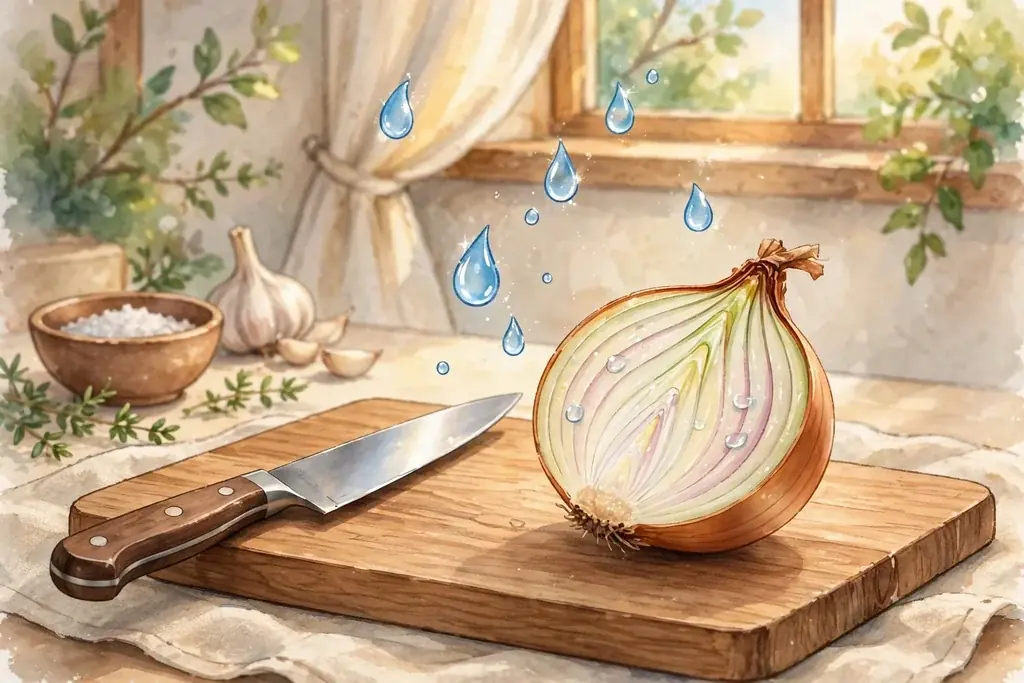
Why Do Onions Make You Cry? The Chemistry of the Tear Gas in Your Kitchen
Every cook knows the moment: the knife goes through the onion, and within seconds your eyes sting, water, and blur your vision. It is not imagination, and it is not a sign of a sensitive constitution. So why do onions make you cry? Because an intact onion is a chemical weapon waiting to be assembled. Cutting it breaks open its cells and sets off a chain reaction that manufactures a genuine lachrymatory agent — a tear gas — right there on your cutting board. The onion is not trying to hurt you, exactly. It is defending itself, and your eyes are collateral damage.
The Defence System Inside an Intact Onion
An onion keeps its chemical weapons in separate compartments, like a bomb with its parts stored in different rooms. Its cells contain sulphur compounds called cysteine sulfoxides, which sit quietly as long as the cell walls hold. They also contain enzymes — biological catalysts — that are kept apart from those compounds. Nothing happens while the onion is whole. The moment your knife slices through, the compartments rupture, the ingredients meet, and the reaction begins.
This is the same basic strategy many plants use. Garlic, leeks, and chives are close relatives of the onion and share much of the same chemistry. But the onion goes one step further than its cousins, and that extra step is the whole reason it makes you cry while garlic does not.
The Chain Reaction, Step by Step
First, an enzyme called alliinase acts on the cysteine sulfoxides released from the broken cells, converting them into sulfenic acids. Those are unstable, reactive molecules that would be mildly irritating on their own. But in onions, a second enzyme then takes over: lachrymatory factor synthase. It rearranges the sulfenic acids into a new compound called syn-propanethial-S-oxide — the lachrymatory factor itself.
That name is worth unpacking. "Lachrymatory" comes from the Latin word for tears, and it means tear-producing. Syn-propanethial-S-oxide is a volatile compound, meaning it evaporates easily and drifts up from the cutting board as a gas. When it reaches your eyes, it irritates the corneal nerves — the sensitive nerve endings on the surface of the eye — and your tear glands respond the way they respond to any irritant: by flooding the eye with tears to wash it away. The onion has, in effect, gassed you with a chemical your own body then tries to flush out.
Why Garlic Does Not Do This
Garlic contains similar sulphur compounds and the same first enzyme, alliinase. Chop garlic and you get the pungent sulphur chemistry that flavours a whole cuisine. What garlic lacks is the second enzyme, lachrymatory factor synthase. Without it, the chain reaction stops at the sulfenic acid stage and never produces syn-propanethial-S-oxide. No lachrymatory factor, no gas drifting into your eyes, no tears. The difference between a tearful onion and a tear-free head of garlic comes down to a single enzyme that onions evolved and their relatives did not.
That evolutionary detail also explains why some onion varieties sting more than others. Sweet onions tend to contain lower levels of the sulphur compounds that feed the reaction, so they produce less lachrymatory factor. Hot, pungent storage onions — the yellow and red workhorses of most kitchens — tend to produce more. The sulphur content of the soil the onion grew in matters too, which is one reason the same variety can sting more in one season than another.
What Actually Helps (and What Does Not)
The folk remedies are endless: chewing gum, holding a match between your teeth, chilling the onion, cutting under running water. Most of them do little, because they do not address the chemistry. The measures that genuinely help work by reducing cell damage, slowing the reaction, or keeping the gas away from your eyes.
The single most effective step is a sharp knife. A dull blade crushes cells across a wide area, releasing far more of the reaction ingredients. A sharp blade slices cleanly through fewer cells, so less lachrymatory factor is produced in the first place. Cutting slowly helps for the same reason: less crushing, fewer ruptured cells, less gas. A 2025 study published in the Proceedings of the National Academy of Sciences confirmed the mechanism, showing that slower, cleaner cutting measurably reduces the release of the irritant.
Chilling the onion for half an hour before cutting also helps, because cold slows the enzymes driving the reaction. Cutting near a fan, or with the range hood running, carries the volatile gas away from your face before it reaches your eyes. And if you wear contact lenses, you may already have noticed they help: the lens acts as a partial shield over the cornea. What does not help much is willpower. Blinking hard and soldiering on does not stop the gas; tears are doing exactly what they are supposed to do, which is washing an irritant out of your eye.
Is the Onion Gas Dangerous?
Unpleasant, yes. Dangerous, no — at kitchen quantities. Syn-propanethial-S-oxide is a genuine irritant, and it is related in a broad chemical sense to the lachrymatory agents used in crowd control, but the amount released by a single onion is tiny and the effect wears off within minutes of finishing the job. Your eyes water, you blink, the tears flush the compound away, and the sting fades. There is no lasting damage from ordinary cooking exposure, and no reason to avoid onions on account of it — though if you find the effect genuinely miserable, pre-chopped frozen onions skip the whole reaction, since the gas disperses during processing.
Quick Summary
Onions make you cry because cutting them ruptures cells and lets the enzyme alliinase convert cysteine sulfoxides into sulfenic acids, which a second enzyme, lachrymatory factor synthase, rearranges into syn-propanethial-S-oxide — a volatile tear gas that irritates the nerves on the surface of your eyes and triggers tears. Garlic lacks that second enzyme, which is why it never makes you cry. A sharp knife, slow cutting, a chilled onion, and good ventilation genuinely reduce the effect.
Frequently Asked Questions
What chemical in onions makes you cry?
Syn-propanethial-S-oxide, known as the lachrymatory factor. It is produced when cutting ruptures onion cells and two enzymes — alliinase, then lachrymatory factor synthase — convert sulphur compounds into this volatile gas, which irritates the nerves on the eye's surface.
Why does garlic not make you cry?
Garlic has the same sulphur compounds and the same first enzyme, alliinase, but it lacks lachrymatory factor synthase — the second enzyme that turns sulfenic acids into the tear gas. Without it, the chain reaction stops before any lachrymatory factor is made.
Does a sharp knife really reduce onion tears?
Yes. A dull knife crushes many cells and releases more of the reaction ingredients, while a sharp knife cuts cleanly through fewer cells, producing less lachrymatory factor. Slow cutting helps for the same reason, and a 2025 PNAS study confirmed the mechanism.
Do sweet onions make you cry less?
Generally, yes. Sweet onion varieties tend to contain lower levels of the sulphur compounds that feed the tear-gas reaction, so they produce less syn-propanethial-S-oxide. Pungent yellow and red storage onions usually sting the most.
Related Guides
- How Long Do Leftovers Last in the Fridge? The 3–4 Day Rule, Explained
- Get Rid of Ants in Your Kitchen: 5 Easy and Natural Ways
- How to Get Rid of Fruit Flies: 6 Methods That Actually Work
External Resources
More in Facts & Explanations

Why Do We See Lightning Before We Hear Thunder? The Flash-to-Bang Rule, Explained
Why Do We See Lightning Before We Hear Thunder? The Flash-to-Bang Rule, Explained Watch any summer thunderstorm and the pattern is always the same: a brilliant fork of lightning splits the sky, and…

How Deep Is the Ocean? The Mariana Trench, Everest, and 6 Mind-Bending Facts
How Deep Is the Ocean? The Mariana Trench, Everest, and 6 Mind-Bending Facts The ocean looks flat and calm from a beach, but below the surface it hides the most extreme landscape on Earth — canyons…
Why Is the Ocean Salty? 6 Fascinating Facts About the Sea
Why Is the Ocean Salty? 6 Fascinating Facts About the Sea Swallow a mouthful of river water and it tastes like nothing. Swallow a mouthful of seawater and you will never forget it. Yet the same rain…