
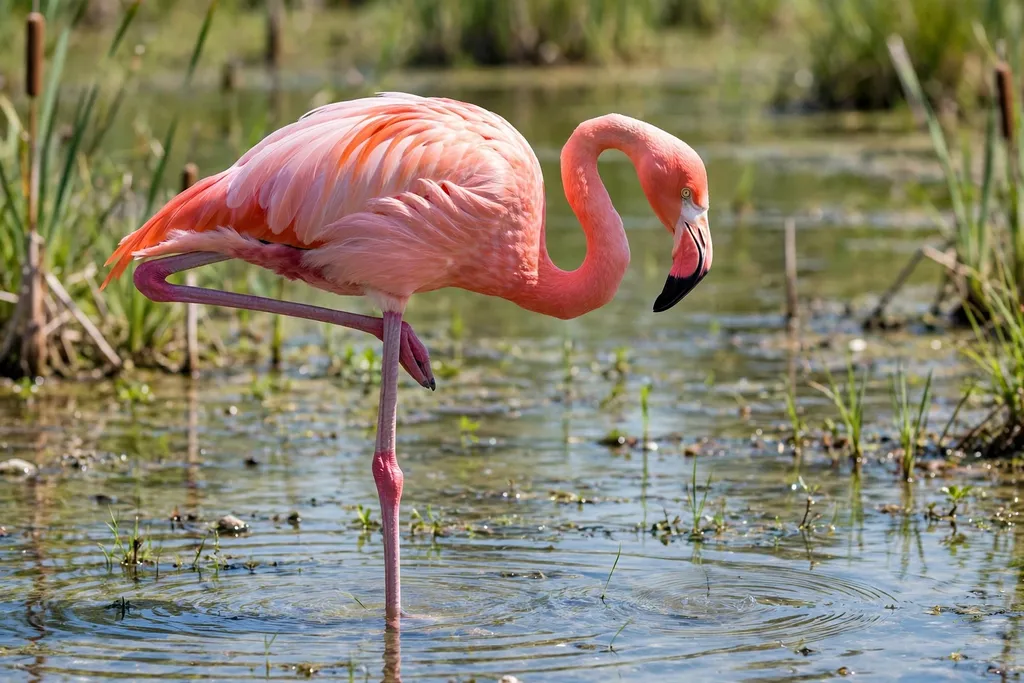
Why Do Flamingos Stand on One Leg? Rest, Balance, and Heat
Visit any zoo lagoon or tropical shoreline and you will see the same strange tableau: a flock of flamingos, pink and motionless, each balanced on a single spindly leg while the other leg dangles or tucks neatly into the belly feathers. Some birds even sleep like this, heads tucked back over their shoulders, apparently unbothered by a pose that would have a human wobbling within seconds. So why do flamingos stand on one leg? For years the popular answer was simple: to keep warm, or to rest one leg at a time. The real story, uncovered by two careful studies, is more interesting than either guess alone. The evidence now points to a combined explanation: the pose saves muscular effort and can also reduce heat loss, and scientists do not agree on a single cause because both mechanisms appear to be at work.
The Short Answer: A Pose That Costs Almost Nothing
Flamingos spend long hours standing in shallow water, often doing very little. Feeding, preening, and resting all happen on their feet, so an efficient resting posture matters a great deal to them. Standing on one leg turns out to be remarkably cheap, in energy terms, because of the way a flamingo leg is built. When the bird settles its weight directly over one foot, the joints of that leg lock into a stable position that gravity itself holds in place, rather than muscles straining to keep it there. At the same time, tucking the other leg up against the warm body takes it out of the water, where a bare, skinny leg would otherwise lose heat to the surroundings. One posture, two benefits: less effort and less heat loss. Neither benefit cancels out the other, and that is why researchers now tend to describe the behaviour as having more than one function rather than a single hidden purpose.
First, a Flamingo Leg Is Not What You Think It Is
Part of the confusion comes from flamingo anatomy, which is easy to misread. What looks like a long, backwards-bending knee halfway up the leg is actually the ankle joint. The true knee is tucked up inside the body feathers, near the hip. The visible lower leg is mostly foot and ankle bones, extended into a long, thin strut. This matters because the locking mechanism depends on the alignment of those joints. When a flamingo stands on one leg, it leans slightly forward so that its foot sits directly beneath the centre of its body. That shift in weight pulls the hip and knee joints into a position where they brace against each other, and gravity keeps them there. It is less like balancing on a tightrope and more like a folding chair clicking into its open position: once it is set, it stays set without constant adjustment.
This also explains why the birds look so still. A human standing on one leg must make constant small corrections with ankle and leg muscles, and the sway is visible. A resting flamingo barely sways at all. The stillness is the clue that something other than active muscular control is doing the work, and it was that stillness that prompted researchers to look more closely at what the leg joints were actually doing.
What the Zoo Study Found: Water, Temperature, and Resting
The heat-conservation side of the story comes from an observational study by Matthew Anderson and Sarah Williams, published in 2010 in the journal Zoo Biology. They watched Caribbean flamingos in a zoo setting and recorded when the birds rested on one leg and when they stood on two. Two patterns stood out. First, the flamingos rested on one leg more often when they were standing in water than when they were standing on land. Second, they adopted the one-legged resting pose less often as the temperature rose. Both patterns fit the heat-conservation idea neatly. A flamingo standing in cool water loses heat through its long, unfeathered legs, so tucking one leg up into the warm plumage removes half of that exposed surface. On a hot day, or on dry land, that saving matters less, so the birds bother with the pose less often.
It is worth being precise about what this study showed and what it did not. It showed a correlation between conditions and behaviour that supports a heat-conservation role: more one-legged resting in water, less of it in warmer conditions. It did not measure exactly how much heat a flamingo saves by tucking one leg away, and no reliable figure for that saving should be quoted as settled fact. Behavioural patterns like this are strong hints, not thermometers. Still, the pattern was consistent enough that heat conservation has remained a serious part of the explanation ever since, rather than being dismissed as a folk guess.
The 2017 Breakthrough: A Passive Stay Mechanism
The effort-saving side of the story arrived with a 2017 study by Young-Hui Chang and Lena Ting, published in Biology Letters. Chang and Ting wanted to answer a question nobody had actually tested: how much muscular effort does one-legged standing really require? Their approach was direct, and a little startling. They tested live flamingos on a force platform, a device that measures sway and the point where force meets the ground. Quiet, resting birds swayed far less than alert, active birds, which is the opposite of what you would expect if the pose demanded constant muscular correction. If muscles were doing the balancing, the sleepy birds should have swayed more, not less.
Then came the cadaver tests. Chang and Ting positioned flamingo cadavers, which by definition use no muscle activity at all, in a one-legged stance. The bodies held the pose stably, with the joints settled into the same alignment seen in living birds. The same cadavers could not be held stably on two legs. That contrast is the heart of the finding: the one-legged posture is mechanically stable on its own, while the two-legged posture needs active muscular control to stay upright. The researchers described the mechanism as a passively engaged gravitational stay apparatus in the upper leg, a structure in which gravity pulls the joints into their locked position rather than out of it. In plain language, the flamingo leg, once set, holds itself up.
This result reframed the older idea about resting legs. Before 2017, a common guess was that flamingos stood on one leg to let the other leg rest, alternating sides to reduce muscle fatigue. The cadaver finding suggests something subtler: the one-legged pose itself may be the restful position, because it demands so little active muscular force. Alternating legs may still happen, but the benefit is not simply giving one leg a break while the other works hard. It is that the working leg barely has to work at all.
Putting the Two Explanations Together
It is tempting to ask which explanation is correct, the heat story or the effort story, but the research suggests that is the wrong question. The two findings answer different questions. Chang and Ting showed how the pose is mechanically possible at low cost. Anderson and Williams showed when the birds choose to use it, and those choices track temperature and water exposure in a way that points to heat conservation. A posture can be both cheap to hold and useful for staying warm. Indeed, the cheapness may be what makes the heat-saving version affordable: if standing on one leg cost a great deal of effort, tucking a leg away to save heat would be a poor trade. Because it costs almost nothing, the bird can afford to use it whenever the thermal benefit is worth having.
That is also why scientists do not agree on a single cause. Some researchers emphasize the biomechanics, arguing that the energy saving is the main driver and the heat effect is secondary. Others emphasize the behavioural pattern, arguing that temperature clearly influences when the pose appears. A fair summary is that the pose saves effort and can reduce heat loss, and the balance between those benefits probably shifts with conditions. A flamingo resting in cool water on a chilly morning may be gaining both at once. A flamingo resting on warm, dry ground may simply be using the most comfortable way to stand still.
What About Sleeping, Drying, and Other Ideas?
Over the years, other explanations have been floated. One is that flamingos stand on one leg to let the other leg dry out, reducing the risk of skin problems from constant immersion. Another is that the pose helps the birds sleep, since a stable, locked leg means a sleeping bird will not topple. A third is that it is simply a comfortable resting posture, like a person shifting weight from foot to foot. None of these has been ruled out entirely, and the sleep idea in particular fits well with the passive mechanism: a bird that can lock its leg and doze without muscular effort has an obvious advantage over one that must stay half-awake to stay upright.
What researchers have moved away from is the idea that the pose requires impressive strength or balance skill. Watch a flamingo long enough and the performance looks extraordinary, but the 2017 work shows the bird is not performing a feat of athletic control. It is using its skeleton the way a horse uses its stay apparatus to sleep standing up: letting anatomy do a job that muscles would otherwise have to do. The marvel is not effort but design.
Do Other Birds Do This Too?
Flamingos are the most famous one-legged resters, but they are far from the only birds that tuck a leg away. Ducks, herons, gulls, and many shorebirds rest on one leg, especially in water or cold weather. In those species the same two benefits probably apply in varying proportions: less exposed leg surface in cold water, and a comfortable resting posture. Flamingos simply take the behaviour to an extreme, because their legs are so long, their wading life is so central, and their joint geometry makes the locked pose so stable. The flamingo is not breaking the rules of bird behaviour. It is showing them at their clearest.
That comparison is also a useful check on the heat idea. If heat conservation were the only explanation, you would expect one-legged resting to appear mostly in cold conditions, and it does tend to increase in cooler water. But birds also rest on one leg in warm weather, on land, and while sleeping, which suggests comfort and energy saving matter too. Behaviour rarely has a single clean cause, and the flamingo is a good reminder of that. A trait can persist because it helps in several ways at once, not because it serves one purpose perfectly.
What to Look for Next Time You See One
The next time you watch flamingos, a few details will tell you what kind of resting you are seeing. A bird with its head tucked back and its body still is likely in the deep, locked rest that Chang and Ting studied. A bird with its tucked leg dangling loosely, rather than folded tight against the body, may be in a lighter rest or just shifting position. Birds in water on a cool day are the most likely to be standing on one leg, following the pattern Anderson and Williams documented. And if you see a whole flock in the pose at once, you are watching a shared resting behaviour, not a coincidence: flamingos are social birds, and rest often spreads through a group.
It is also worth watching the moment a bird switches legs. There is no dramatic wobble or recovery. The bird simply lowers one foot, lifts the other, and settles again, with the same quiet stability. That smooth exchange is exactly what a passive mechanism predicts. If the pose demanded intense muscular control, every switch would be a small balancing act. Instead it looks routine, because for the flamingo, it is.
Quick Summary
Flamingos stand on one leg because the pose is both cheap and useful. Anderson and Williams (2010, Zoo Biology) found that Caribbean flamingos rested on one leg more often in water than on land and less often as temperature rose, supporting a heat-conservation role. Chang and Ting (2017, Biology Letters) showed that flamingos can support their body weight on one leg with little active muscular force, thanks to a passively engaged gravitational stay mechanism, including tests in which cadavers held the one-legged pose stably. The combined explanation is that the posture saves effort and can reduce heat loss, and scientists do not agree on a single cause.
Frequently Asked Questions
Why do flamingos stand on one leg?
Research points to two complementary reasons. The pose costs very little muscular effort because the leg joints lock passively under the bird's weight, and tucking the other leg against the warm body can reduce heat loss in water. Scientists do not agree on a single cause, and both benefits likely matter.
What did the 2017 flamingo study actually prove?
Chang and Ting showed that flamingos can support their body weight on one leg with little active muscular force. Flamingo cadavers held a stable one-legged pose with no muscle activity, while the same cadavers could not be held stably on two legs, pointing to a passively engaged gravitational stay mechanism.
Does standing on one leg keep flamingos warm?
It can help. Anderson and Williams (2010) found that Caribbean flamingos rested on one leg more often in water than on land and less often as temperature rose, which supports a heat-conservation role. The study did not establish an exact percentage of heat saved, so no precise figure should be quoted.
Do flamingos sleep while standing on one leg?
Yes, flamingos can and do sleep in the one-legged pose. The passive joint lock means a resting bird does not need constant muscular effort to stay upright, which is why sleeping birds on a force platform swayed even less than alert birds in the 2017 study.
Related Guides
External Resources
More in Other Curiosities

Why Do We Knock on Wood? The Surprisingly Modern Origin of an Old Superstition
Why Do We Knock on Wood? The Surprisingly Modern Origin of an Old Superstition You have just said something tempting fate — "I have never had a car accident," or "the baby slept through the night for…

Why Do Golf Balls Have Dimples? The Accident That Doubled the Drive
Why Do Golf Balls Have Dimples? The Accident That Doubled the Drive It looks like a manufacturing defect, and it is the opposite: the hundreds of tiny craters on a golf ball are the reason a drive…

Why Are School Buses Yellow? The 1939 Decision That Stuck
Why Are School Buses Yellow? The 1939 Decision That Stuck Every school bus in North America wears the same shade — not just yellow, but one specific yellow-orange with its own official name. Nobody's…